BlasiosVictory

  • Subscribe to our RSS feed.
  • Twitter
  • StumbleUpon
  • Reddit
  • Facebook
  • Digg
Showing posts with label translation. Show all posts

Thursday, 5 September 2013

Goodbye to the Summer / Back in Class

Posted on 19:19 by Unknown
Rutgers undergraduate Paul Robeson
with fellow football players
On Tuesday, I resumed my old new fall rhythm. "Old," because I have been teaching for more than a decade now (though last year started at Rutgers University in Newark's campus); "new" because instead of my usual gearing up for hopping on a plane to return to a different home and readjust to a different city, I returned to my routine from last fall, and via public and bipedal transportation alone, was standing in front of my class, opening the semester.

As I was riding to campus I realized this past July marked the first time in 13 years--since 2000--that I had spent a continuous year at home (work-related trips excepted) in New Jersey. My prior dozen years weren't itinerant as Erasmus's career, of course, nor comparable to the experiences of numerous friends and colleagues, who have hopscotched all over the country for short-term and longer-term gigs, but it did sear into my consciousness that September equalled leaving home, whether for part of a week (as when I commuted to Providence) or a sizable chunk of each season.

Acclimation to the new rhythms perhaps accounts for why, for the first time in my career, I did not feel the blizzard of nerves that usually overwhelms me before my first course meeting. I still sweated through my clothing, got through only half my notes, and did not copy enough syllabi given the number of students who (since I have tended to assume that they will download it in advance, and my classes have tended to grow at Rutgers after the first week, rather than shrinking), but the flow of teaching went more smoothly, and felt less wracking too.

This was the case even though I am teaching a new preparation, "Foundations of Literary Studies", a required course for English majors, but I am excited about the opportunity to guide students through the material. As part of our first class we read and talked about two of my favorite poems Rainer Maria Rilke's "The Archaic Torso of Apollo" and Gwendolyn Brooks's "we real cool," and this weekend they will read an essay by Terry Eagleton before launching into the first nonfiction prose work (they are reading that genre, as well as poetry, fiction, drama, and graphic literature), The Travels of Dean Mahomet (which is free online at the University of California Press's website, if you want to check it out).

Another aspect of the fall is greater departmental responsibilities with one of my university homes. With two of my colleagues, including my chair, in African American and African Studies on sabbatical, I have been named as acting chair till January. I undertook a great deal of work related to this temporary post this summer, but there are still some major tasks to complete before December rolls around. One unexpected result of my spring AAAS teaching was an email I received this summer from a drama student at the Université de Lomé (in Togo) who has studied some African American literature, and had downloaded my course syllabus and inquired about some of the texts. I responded, sending him an essay by Richard Wright, but we have continued corresponding, and he passed on the names of some of Togo's leading poets, fiction writers and playwrights, only one of whom I'd heard of, so I look forward to delving more deeply in Togolese literature.

It's still difficult to believe the summer is over, even if not officially. This was one of my most productive writing summers in a long time. I completed a number of larger prose projects, one of which I continue to call a story but really is a novella, several of the others more clearly long short stories. Earlier in the year, as I was riding on the subway back from the Countee Cullen tribute event at Woodlawn Cemetary with Patricia Spears Jones and Rowan Ricardo Phillips and talking about having written a draft of what was essentially a novella after 10 years of intermittently leading the novella half of the year-long creative writing sequence to my Northwestern undergraduates, Rowan diagnosed my approach as "empathic composition." I think this is right in part; there is also the small window of the summer (this one without any travel) to complete anything, so I believe I successfully pressed rather quickly out of the scant grapes available.

I also finished revising and refining, with A Bolha Editora editors Rachel Gontijo Araújo and Stephanie Sauer the translation of Hilda Hilst's Letters from a Seducer, and cannot wait to see it in print later this month or early next. I wrote and delivered a short paper on the process of translating it, and perhaps I'll publish this at some point. The book will open, however, with a beautiful introduction by Princeton professor and Brazilian literary and cultural scholar Bruno Carvalho. I'm especially proud that I was able to accomplish this while teaching, though it would be wonderful to receive a fellowship to aid in future larger scale translations.

With the intense focus on my own writing and preparations for this fall I was unable to blog as frequently as I like. I hope to resume posting a bit more frequently. I still have unfinished posts in the queue, including a short tribute to Seamus Heaney, whom I have the honor of having kept from a good night of sleep--I'll say more about that soon--and perhaps some reviews, though my efforts in that area have tended to appear elsewhere (Drunken Boat among other places). Here's an exciting, productive fall for all J's Theater readers--and by "exciting," I do not mean another hurricane or tropical storm. Sandy was enough for a lifetime, or two!
Read More
Posted in fiction, Hilda Hilst, literary studies, literature, novella, Rutgers Newark, teaching, Togo, translation, writing | No comments

Thursday, 13 June 2013

Today: Brazil's Marquise de Sade: On Translating Hilda Hilst's "Cartas de um Sedutor"

Posted on 10:06 by Unknown
Today, at 1:15 pm, free, quite informal, and at the New York Public Library's Research Branch at 42nd St. and Bryant Park, in the South Court Auditorium, downstairs!


Read More
Posted in Hilda Hilst, lecture, New York Public Library, talk, translation | No comments

Wednesday, 10 April 2013

Poem/Translation: Xavier Villaurrutia

Posted on 14:21 by Unknown
I could not possibly post poetry about the night without again posting a poem by Xavier Villarrutia, one of whose poems I translated and posted back in January. Here is another, "Cuando la tarde," which, like all his poems, I enjoy reading aloud in the Spanish and then in the English. The lush sensuality of his poems, his language that approximates touch while also capturing a particularly powerful experience of yearning, is on full display here. The poem's messages are self-evident, but I would only call attention to the final line, where the heart of the matter lies, and, both in his Spanish and the English translation, bursts forth at the end of the line: el deseo. Desire, indeed, rising like that ash, that dust, that smoke, that absence of light, in the night.

***

CUANDO LA TARDE

Cuando la tarde cierra sus ventanas remotas,
sus puertas invisibles,
para que el polvo, el humo, la ceniza,
impalpables, oscuros,
lentos como el trabajo de la muerte,
en el cuerpo del niño,
vaya creciendo;
cuando la tarde, al fin, ha recogido
el último destello de luz, la última nube,
el reflejo olvidado y el ruido interrumpido,
la noche surge silenciosamente
de ranuras secretas,
de rincones ocultos,
de bocas entreabiertas,
de ojos insomnes.

La noche surge con el humo denso
del cigarillo y la chimenea.
La noche surge envuelta en su manto de polvo.
El polvo asciende, lento.
Y de un cielo impasible,
cada vez más cercano y más compacto,
lluevo ceniza.

Cuando la noche de humo, de polvo y de ceniza
envuelve la ciudad, los hombres quedan
suspensos un instante,
porque ha nacido en ellos, con la noche, el deseo.

Copyright © Xavier Villarrutia, from Nostalgia de la muerte. Introduction by César Antonio Molina. Madrid: Huerga y Fierro Editores, 1999. All rights reserved.

WHEN EVENING

When evening closes its distant windows,
its invisible doors,
so that the dust, the smoke, the ash,
impalpable, obscure,
slow as the work of death
in the body of a child,
keep growing;
when evening, finally, has recovered
the last glimmer of light, the last cloud,
the forgotten reflection and the interrupted sound,
night surges silently
from secret slots,
from hidden corners,
from half-open mouths,
from sleepless eyes.

Night surges forth with the dense smoke
of cigarette and chimney.
Night surges forth wrapped in its mantle of dust.
The dust rises, slowly.
And from an impassive sky,
each time closer and more compact,
ash rains.

When the night of smoke, of dust and ash
envelops the city, men stay
suspended but an instant,
because in them is born, with the night, desire.

Copyright © Translation by John Keene, 2013. All rights reserved.
Read More
Posted in international poetry month, lgbtiq writing, Mexican poetry, night, poetry, queer, translation, Xavier Villarrutia | No comments

Tuesday, 26 March 2013

The Next Big Thing

Posted on 09:16 by Unknown
THE NEXT BIG THING

Thank you to poet and lovely person Sheila Maldonado, for tagging me for this. I usually eschew posts of this sort, since as Samuel R. Delany has said it is better not to talk too much publicly about things that you have not completed, but since I agreed to do it, I'm going follow through.

What is the working title of the book?
There are several, but I'll mention two. One is a book I just finished translating, entitled Letters from a Seducer, by the Brazilian author Hilda Hilst (1930-2004). Another, which still has a bit to go, is a novel entitled Palimpsests. And there are other projects (fiction, poetry, etc.), as always, in the crockpot.

Where did the idea come from for the book?

The translation was suggested by the Brazilian publisher, as I'd written the introduction to a translation by her and an author, and greatly admired their work. (This is the second book I have translated from Portuguese; the first, by the out gay Brazilian legislator and reality TV star, Jean Wyllys, remains unpublished, except for a few individual stories here and there.) For my own novel, the idea came from attending an OutWrite conference in Boston many moons and skies ago, and seeing a tiny historical note. It took me years to figure out what I wanted to do with the idea, and then it has taken a while to write it.

What genre does your book fall under?

Fiction and fiction.

What actors would you choose to play the part of your characters in a movie rendition?

I would say no one is going to make a film of Hilst's novel anytime soon, except that if 1) Lars von Trier, 2) Bruce La Bruce, or 3) Rosa von Praunheim could find a screenwriter to do it, it might at least have a chance. The text is beyond the American cinematic imagination, for the most part. As for the novel I'm writing, Idris Elba would be my first choice for the main male character, and Kimberly Elise would be great as his sister, who is a significant figure in the work. Anthony Mackie would probably be very good as the third major character. I could fill entire blog post with actors for the other parts, but will just ask you to imagine any number of talented actors and actresses, ranging from Mahershala Ali to Angela Bassett.

In terms of the major white characters, I have no idea whatsoever, save for the 20-something daughter of the main character's nominal boss. That should be played by someone with a somewhat grave, fragile face, and an ability to show tremendous acting restraint.

There are a range of characters, so it would give an array of actors, especially black and brown ones, some jobs.

What is the one sentence synopsis of your book?

A man has a stranger appear on his doorstep one night, and he has to help him create a new life.

How long did it take you to write the first draft of the manuscript?

Almost forever, minus a kaput computer and a half.

Who or what inspired you to write this book?
With the translation, my inspiration is always Langston Hughes, who was a true person of letters, with translation as one aspect his prolific practice. It's an aspect of his career that people often leave out, but it is one I have taken to heart. Melvin Dixon was also a great translator, writer, and scholar, and someone I deeply admire still, and I would add my former colleague Reginald Gibbons, as well as Marilyn Hacker and Nathanaël, among many, as inspiring writer-translators that come immediately to mind.

With my novel the historical note I came across was the major inspiration. Also years ago my partner's late aunt gave him a book about early African American literature, and it turns out that the real-life person on whom my character is based was a figure notable enough to appear in that book, and even appears in this book. So that was inspiration too. Then there are so many writers and artists and thinkers I have read, followed, admired, known, many of them no longer with us, many lost to AIDS or psychological troubles, and I often think that either with this book or another, I will eventually follow Clarice Lispector's strange little introductory method in The Hour of the Star and list all these "imaginary artist friends,"as Sheila labeled them in her response, either at the beginning or the end of the book. Also, see Delany, Samuel R., Jr.

What else about your book might pique the reader’s interest?

The Hilst book is the very definition of genre-breaking, and required me to learn more words for sexual terms in Portuguese than I know in English. English is vocabulary-rich, but comparatively sex-vocabulary poor.

My novel is set in 1804. How often do you read a book set in that year in America? And there are no electric lights, no cars, no airplanes, no TVs, nothing of the sort. They wear smallclothes and Empire-style dresses and ill-fitting shoes. Everything carries a thin veneer of candle smoke, and the fragrance of urine. There were coaches and the beginnings of plumbing and a museum exhibiting little wax statuettes of Othello and Harvard College and free black people, some queer, too. It was quite a time!

Will your book be self-published or represented by an agency?
The Hilst book is to be published this fall by Nightboat Books, based in NYC, in conjunction with Abolha Editora in Rio de Janeiro (I believe). They published the first translation into English of Hilst, and I highly recommend it. I do have an agent, so with my novel we shall see.

My tagged writers for next Wednesday are:
Reginald Harris
Lee P. Jones
Read More
Posted in 19th century, Boston, Hilda Hilst, literature, Next Big Thing, novel, queer, Samuel R. Delany, translation, writing | No comments

Friday, 15 March 2013

Quote (Translation): Hilda Hilst

Posted on 19:51 by Unknown
"He was telluric and unique. He was dreaming. He dreamed of goodbyes and shadows. He dreamed of gods. He was cruel because he had always been desperate. He encountered a human-angel. So that they might live together, on Earth, forever, he cut off his wings. The other killed himself, plunging into the waters. I am still alive today. I am old. At night I drink a lot and look at the stars. Often, I write. Then I reconsider that one, the snowy breath, the desperation. I lie down. Austerely, I dream that I sow black beans and wings across a dark, sometimes mother-of-pearl, earth."

-- Copyright © by Hilda Hilst, from Letters from a Seducer (Cartas de um sedutor), originally published in 1991 by Editora Paulicéia, reprinted in 2001 by Globo Editora. Translation, copyright © by John Keene, 2013.
Read More
Posted in Brazilian literature, fiction, Hilda Hilst, translation | No comments

Tuesday, 15 January 2013

Poem/Translation: Xavier Villaurrutia

Posted on 21:14 by Unknown
For a long time I've loved the poetry of Xavier Villaurrutia (1903-1950), one of the greatest poets in Mexican and Latin American literature, and I've read translations of his work that I liked, but I've only tinkered with translating one or two poems of his, publishing none of them on here. Back in September 2005, however, I did publish one of Rachel Benson's translations, of his poem "Love Is an Anguish, A Question," and also posted my typical potted biography of the poet as an introduction.

Recently during this tiny breather between classes I decided to tackle one of his masterpieces that I mentioned in that post, the haunting "Nocturno de Los Ángeles," one of a group of poems in this genre, the "nocturne," that Villaurrutia published in his collection "Nostálgia de Muerte" in 1938. He had previously published an entire collection in 1933 entitled "Nocturnos." This exceptional example of the form is, as you will see, more openly homoerotic than its predecessors, though all of the ones he wrote, as well as many of his other poems, possess a queer thematic undertow.

The very idea of a poem invoking and celebrating the night and nocturnal life suggests and opens up queer possibilities for a gay poet, especially one such as Villaurrutia, who wrote before the more widespread acceptance, in Mexico and elsewhere, of LGBTIQ literature. In the poem "Nocturno," he offers a definition of sorts, beginning "Todo lo que la noche/dibuja con su mano/de sombra;/el placer que revela/el vicio que desnuda" (Everything that the night/draws with its shadowy/hand;/the pleasure it reveals/the ugliness it lays bare." There is Villaurrutia's thematics of the "nocture" in a stanza. Turning darker in tone and imagery towards the end of life, they also point to his chief strategy for revealing and concealing at the same time his interests, as a man and poet, among them an abiding cosmopolitanism, a probing interest in metaphysics and the deeper realities behind and beyond the surface of things, and, rather obviously, queer desire and sociality.

Often in Villaurrutia's poems the rhetoric and discourse cut, at differing angles, through the abstractions; what is not said, "the secret" he broaches below, "shatters" into revelation nevertheless through its presence and invocation. We know it; he chooses to share it with by not sharing it openly. Except below, and in a few other poems. He did not need to hide among his circle of friends, the important group of modernist poets centered in Mexico City, nor was he hiding much when he was translating foreign writers including André Gide and Langston Hughes. His student Octavio Paz, among others, was in on the secret. As all of us who read his poems eventually are.

"Nocturno de Los Ángeles" is one of his most beautiful. It is as strange (with angels, no less) as Rilke, but distinctly Villaurrutia's gem. I recommend reading the English and Spanish aloud, to get the fullest sense of what he's doing. The Spanish, unsurprisingly, casts a greater spell than (my workmanly) English (translation) ever can, at least to my ear. Still, enjoy!

NOCTURNO DE LOS ÁNGELES
to Agustin J. Fink

You could say the streets flow sweetly into the night.
The lights are not so bright that they actually reveal the secret,
the secret that men who come and go know,
because everyone is in on the secret
and nothing would be gained by shattering it
into a thousand pieces
if, on the one hand, it is so sweet to keep
and share it only with the one you choose.

If each one were to say at a given moment,
in only one word, what he thinks,
the six letters of DESIRE would form
an enormous, luminous scar,
a constellation more ancient, more brilliant
than any other.
And that constellation would be like a sex organ burning
in the deep body of the night,
or, better, like the Gemini who for the first time
in their lives
saw themselves brow to brow, eye to eye,
and then took each other in their arms forever.

Suddenly the river of the street peoples with thirsty beings,
they stroll, they pause, they walk on by.
They exchange glances, they dare smiles.
They improbably couple up.

There are shadowy bends and banks,
edges of indefinable and bottomless forms
and sudden blinding shafts of light
and doors that give way to the slightest pressures.

The river of the street stands deserted for a moment.
Soon it seems to rearrange itself by itself
longing to begin again.
For a moment it stays paralyzed, mute, yearning
like the heart between two orgasms.

But a new pulsation, a new beat
casts into the river of the street new thirsty beings.
They cruise, intermingle, lift off.
The fly above the earth.
They swim on foot, so miraculously
that no one would dare to say they were not walking.

They're angels!
They've come down to earth
by invisible ladders.
They come from the sea, that mirror of the sky,
in ships of smoke and shadow,
to find themselves, conjoin themselves with mortals,
to surrender their brows to the thighs of women,
let others feverishly caress their bodies,
as other bodies search for theirs until they find them
as they find them when closing
their lips on the same mouth,
wearing out their mouths unused for so long,
setting free their tongues of flame,
chanting the songs, the pledges and the cursewords
in which men concentrate the ancient mystery
of flesh, blood and desire.

They take assumed names, divinely simple.
They call themselves Dick or John, or Marvin or Louis.
In no way way beyond their beauty can they be
distinguished from mortals.
They stroll, they pause, they walk on by.
They exchange glances, they dare smiles.
They improbably couple up.

They smile maliciously ascending
the hotel elevators
where they can still practice slow and vertical flight.
On their nude bodies are heavenly marks--
signs, stars, blue tattooed letters.
They fall back into bed, drown themselves in pillows
that make them recall, for a moment, the clouds.
But they close their eyes in order to give themselves up
to the pleasures of their mysterious incarnations,
and, when they sleep, they dream of mortals, not angels.

Los Angeles, California

Copyright © Estate of Xavier Villarrutia. All rights reserved.
Copyright © Translation by John Keene, 2013.


NOCTURNO DE LOS ÁNGELES
a Agustín J. Fink

Se diría que las calles fluyen dulcemente en la noche.
Las luces no son tan vivas que logren desvelar el secreto,
el secreto que los hombres que van y vienen conocen,
porque todos están en el secreto
y nada se ganaría con partirlo en mil pedazos
si, por el contrario, es tan dulce guardarlo
y compartirlo sólo con la persona elegida.

Si cada uno dijera en un momento dado,
en sólo una palabra, lo que piensa,
las cinco letras del DESEO formarían una enorme
cicatriz luminosa,
una constelación más antigua, más viva aún que las otras.
Y esa constelación sería como un ardiente sexo
en el profundo cuerpo de la noche,
o, mejor, como los Gemelos que por vez primera en la vida
se miraran de frente, a los ojos, y se abrazaran
ya para siempre.

De pronto el río de la calle se puebla de sedientos seres,
caminan, se detienen, prosiguen.
Cambian miradas, atreven sonrisas,
forman imprevistas parejas...

Hay recodos y bancos de sombra,
orillas de indefinibles formas profundas
y súbitos huecos de luz que ciega
y puertas que ceden a la presión más leve.

El río de la calle queda desierto un instante.
Luego parece remontar de sí mismo
deseoso de volver a empezar.
Queda un momento paralizado, mudo, anhelante
como el corazón entre dos espasmos.

Pero una nueva pulsación, un nuevo latido
arroja al río de la calle nuevos sedientos seres.
Se cruzan, se entrecruzan y suben.
Vuelan a ras de tierra.
Nadan de pie, tan milagrosamente
que nadie se atrevería a decir que no caminan.

¡Son los ángeles!
Han bajado a la tierra
por invisibles escalas.
Vienen del mar, que es el espejo del cielo,
en barcos de humo y sombra,
a fundirse y confundirse con los mortales,
a rendir sus frentes en los muslos de las mujeres,
a dejar que otras manos palpen sus cuerpos febrilmente,
y que otros cuerpos busquen los suyos hasta encontrarlos
como se encuentran al cerrarse los labios de una misma boca,
a fatigar su boca tanto tiempo inactiva,
a poner en libertad sus lenguas de fuego,
a decir las canciones, los juramentos, las malas palabras
en que los hombres concentran el antiguo misterio
de la carne, la sangre y el deseo.
Tienen nombres supuestos, divinamente sencillos.
Se llaman Dick o John, o Marvin o Louis.
En nada sino en la belleza se distinguen de los mortales.
Caminan, se detienen, prosiguen.
Cambian miradas, atreven sonrisas.
Forman imprevistas parejas.

Sonríen maliciosamente al subir en los ascensores de los hoteles
donde aún se practica el vuelo lento y vertical.
En sus cuerpos desnudos hay huellas celestiales;
signos, estrellas y letras azules.
Se dejan caer en las camas, se hunden en las almohadas
que los hacen pensar todavía un momento en las nubes.
Pero cierran los ojos para entregarse mejor a los goces
de su encarnación misteriosa,
y, cuando duermen, sueñan no con los ángeles sino con los mortales.

Los Angeles, California
Read More
Posted in lgbtiq literature, Los Angeles, Mexican poetry, Modernism, poetry, queer, translation, Xavier Villarrutia | No comments

Monday, 10 September 2012

Poem & Translation: Paul Verlaine + Reading at NY Botanical Garden

Posted on 16:30 by Unknown
The bridge over the recreated pond
The bridge over the lily pond
Though I have may pots in the kiln right now, I want to let too a week elapse since an event I participated in this past Saturday, at the majestic New York Botanical Garden, which is located in the Bronx: the final reading in the Poetry Society of America's Monet to Mallarmé series, this one dedicated to the poems of Paul Verlaine (1844-1896), the symbolist master, queer pioneer and among the truest musicians of French lyric poetry.

Introduced by PSA's Charif Shanahan, poets, critics and translators Patrick Phillips, Charles Ruas and I read just yards from the Botanical Garden's exhibit and recreation of Claude Monet's garden at Giverny in its Enid Haupt Conservatory. Each of us drew from the rich archive of Verlaine's works. I elected to read both in French and in English, with the translations all by Martin Sorrell.  Patrick Phillips focused on Verlaine's romantic poems, while Charles Ruas explored Verlaine's work after he was sentenced to prison for his 1873 shooting of Arthur Rimbaud (1854-1891), the young seer among poets with whom Verlaine fell madly, crazily in love, one of several amours fous that marked Verlaine's life.

Here is one of the poems I read, certainly one of Verlaine's most famous and exquisite, "Chanson d'automne," or Autumn Song. It is nearly untranslatable, in part because in any other language, including French's Romance cousins, it loses so much of its innate homophonous, rhyming, and assonant music, beginning with the first stanza's vowel sounds ("automne," "monotone"), some very nasal ("sanglots longs"), but all of which mimic and embody the "monotonous" music of (Autumn's) violins. Nevertheless, here is the poem, and my admittedly crude translation. Autumn nevertheless is upon us, and so Verlaine's gem feels right.  If you are in New York and are thinking of an interesting trip outside Manhattan and Brooklyn, the Botanical Garden is only 20 minutes by train from Grand Central Station, about $3.75 (I think) each way, and recreating Monet until October 21, 2012!

CHANSON D'AUTOMNE
Les sanglots longs
Des violons
De l’automne
Blessent mon cœur
D’une langueur
Monotone.

Tout suffocant
Et blême, quand
Sonne l'heure,
Je me souviens
Des jours anciens
Et je pleure

Et je m'en vais
Au vent mauvais
Qui m'emporte
Deçà, delà,
Pareil à la
Feuille morte.
Poem by Paul Verlaine (1844-1896). It initially appeared in his first collection,Poèmes Saturniens, in 1866.

AUTUMN SONG
The drawn-out sobs
Of the violins
Of autumn
Wound my heart
With a languorous
Boredom.

All worked up
And pale, when
The hour nighs
I recall
Days of old
And I cry

And I'm off
On an ill wind
That carries me
Hither, thither
Just as with a
Fallen leaf.

Copyright translation © by John Keene, 2012.

Here are a few photos from the Monet's Garden exhibit. Enjoy!
UPDATE: A photo from Charif Shanahan/PSA:

A listener, Phillips, me, Ruas, at the event


Photos (by me)
Enid Haupt Conservatory at New York Botanical Garden
In the NY Botanical Garden's Monet's Garden Exhibit
The NY Botanical Garden's Monet's Garden Exhibit
Flowers at the NY Botanical Garden's Monet's Garden Exhibit
The pond
Bamboo stalks
Flowers at the NY Botanical Garden's Monet's Garden Exhibit
Une abeille!
Read More
Posted in flowers, French poetry, lyric, New York Botanical Garden, Paul Verlaine, poetry, Poetry Society of America, symbolism, translation | No comments

Wednesday, 25 July 2012

Updates + Congratulations & News

Posted on 21:54 by Unknown
These summer days are zooming by. Although I haven't even been back in New Jersey for a full month, it feels almost or even double that long.  As I mentioned in a post a few weeks back I'd begun to set up my new office, and now it's much further along. I still need to figure out how to get into half of my desk, which appears to be locked from the inside (?), get a few office supplies, and hang more artwork (including a vèvè of La Sirène, who kept watch over my office in Evanston), but things are proceeding pretty well.

The office, coming into order
The office, now mostly in order


The books, in order on the shelvesI have several DUPLICATES of books, so I am again putting out a call to find out if any J's Theater readers would like a copy of one of them. If not, I will donate them.

The books are:

Ray Bradbury, Fahrenheit 451
Raymond Carver, Where I'm Calling From
Luis Cernuda, Selected Poems (translated by Reginald Gibbons)
Therese Hak Kyung Cha, Dictée
Jason Epstein, The Book Business
William Faulkner, The Sound and the Fury
Allen Ginsberg, Howl
Thomas Glave, Whose Song? and Other Stories
Nalo Hopkinson, Midnight Robber
Tyehimba Jess, leadbelly
Adrian C. Louis, Bone & Juice
Michael David Lucas, The Oracle of Stamboul (my former undergraduate student!)
Claudia Rankine, Don't Let Me Be Lonely
Adrienne Rich, Diving Into the Wreck
Nathanaël West, Miss Lonelyhearts & The Day of the Locust (2 copies)

A certain very dear person to me was quite skeptical that Newark has a subway system--it does, called the Newark Light Rail, and comprising the old Newark City Subway and an extended light rail component--so here are a few images of it and the Rutgers University-Newark campus. From Newark's Penn Station to the campus, it's 2 stops, or 70 cents. I was a bit incredulous at first at this price, but yes, it's cheaper to go back and forth to campus on Newark's subway than either one way on the PATH, the Hudson-Bergen Light Rail or New York's MTA. The trains are almost identical to the light rail trains that run along the eastern spine of Hudson and Bergen counties, from Bayonne, through Jersey City, to Weehawken. But they do slip underground at first, before ascending to road grade. One line stays in Newark, I believe, and the other runs all the way to Bloomfield. Another line takes you to the now quite famous New Jersey Performing Arts Center, and also to the Bears and Eagles Riverfront Stadium.

The entrance to the Newark subway/lightrail station, in Newark's Penn Station
The entrance, at Newark's Penn Station

photo
A mural in the Newark Penn Station stop

Newark subway/light rail train rolling in
One of the trains, barreling the station

Washington St. subway station, Newark
The Washington St. station entrance, in University Heights

Looking up the hill, Rutgers Newark
On campus, looking up the hill, toward New Jersey Institute of Technology

University Heights, Newark
One of the directional signs, along the campus


***

Now, for a few announcements and congratulations. First, to Dr. Laura E. Passin, newly minted Ph.D., who successfully defended her dissertation "The Lyric in the Age of Theory: The Politics and Poetics of Confession in Contemporary Poetry." Smart, brimming with insight, covering a range of noteworthy poets in unexpected combinations, theoretical without ever turning to theory as a crutch, it is a work much like its author, an incredibly sharp and talented poet and budding scholar I've had the good fortune to get to know from the time she passed her oral exams with panache, on through all of her dedicated efforts on behalf of the Poetry and Poetics Colloquium and the poetry workshops the undergraduate students conducted with the students at Evanston Township High School, and it has been a particularly joy to serve on her thesis committee. Congratulations to Laura, now Dr. Passin, who has a great book on poetry with her dissertation, and a great future ahead of her!

Congratulations also to Nathanaël, someone whose work and works in the world never fail to astonish me, who received a PEN American Center Translation Fund Grant, to support her translation of French writer Hervé Guibert's Mausoleum for Lovers. According to the site, this work is "a posthumous collection of the private journals that the well-known novelist and AIDS activist kept from 1976-1991—a series of literary snapshots of the author’s various objects of desire and mourning and already a classic of French autobiography," and will be published by Nightboat Books.  The PEN blog even features a snippet of Nathanaël's translation.  Congratulations again to Nathanaël, and it goes without saying that I am looking forward to her translation of this work and--I'll say more later--another work she has translated, which will appear this fall.

I've been waiting for the starter's gun to sound and permit me to announce the winner of the first Drinking Gourd Chapbook Poetry Prize, sponsored by the Northwestern University Poetry and Poetics Colloquium in conjunction with the Northwestern University Press, and she is Kristiana Rae Colón! As a member of the inaugural committee of judges, I can attest to how her book of poems, promised instruments, crackled with spirit and soul, and demonstrated how craft can transform one's life and imagination into powerful, memorable poetry. The press will also publish a companion chapbook, Closest Pronunciation, by poet Ed Roberson, who will be writing the introduction to Kristiana's début, and it too is full of poems which show a poet at the height of his girts rendering everyday experiences into artfully cadenced, pitched lyric. The 2013 chapbook guidelines are open, so if you qualify, please submit your work!

And finally, in the July 20, 2012 New York Daily News, the ever-amazing Kwame Dawes discusses the newly established African Poetry Book Series, an exciting, multi-dimensional program under the auspices of the University of Nebraska-Lincoln’s African Poetry Book Fund, that will include books to be published beginning in January 2014, and more, and which I have been fortunate to have been involved with since its conception. Some very exciting titles are in the works, and as things develop I'll announce them here, but many thanks to Kwame and to all the other poets, writers, sponsors, as well as Nebraska-Lincoln, for making this happen!
Read More
Posted in African Poetry Book Series, Drinking Gourd Chapbook Poetry Series, Ed Roberson, Kristiana Rae Colón, Kwame Dawes, Nathanaël, Newark, Newark subway, Northwestern, PEN, poetry, Rutgers Newark, translation | No comments

Friday, 29 June 2012

Translation: Juan Vico [Updated]

Posted on 16:55 by Unknown
I mentioned that I'd found several compelling books of poetry while away, and I've already posted a few pieces by one of the poets, so let me take a break from packing and cleaning to post my translation of a poem by another of those writers, Juan Vico, whose collection Still Life received the XXVIII Premi de Poesia <<Divendres culturals>> in 2011, and was published by the press of the Autonomous University of Barcelona (Universitat Autònoma de Barcelona). Flipping through the book I found the combination of lightness and depth, the references to contemporary culture and high art, the relative straightforward quality of the Spanish, and the subtle lyricism all drawing me in.

In the poem below, you can see what I'm talking about as the speaker addresses the late, unsurpassingly strange master artist Balthus (Balthasar Klossowski, 1908-2001), whose portraits of young women do feel out of time and deeply suffused with eros yet also carry, at least to me, an air of something lost, missed, amiss, something quite sinister. The speaker has an idea of what--or who--is behind that, and it isn't just the poet, and that agent is also working its seductive magic on the speaker too.

One translation note: the verb otorgar usually means to "grant" or "agree to" or even "condescend to," so I had to find an English word that would convey the meaning while also fitting the other requirements of the poem. English fortunately has an incredibly rich vocabulary, and the quite old, somewhat formal-sounding verb "bestow" seems to capture all these meanings, while also creating a rhyme with "shadows" in the first line of the first stanza, and maintaining the consonant sibilance ending each of the first four lines. It is always a challenge to capture the beautiful sonorities of the Romance languages in English, all of which have baked into them the possibility of much internal rhyme and much more regular rhythm, but English has its own resources and I try, as best I can, to utilize them in service of making the translation as effective as I can.

I'd never come across Vico's work before, but according to his book jacket, he was born in Badalona in 1975, and studied Audivisual Communication and has a Masters in Literary Theory and Comparative Theory.  He's published at least one other book of poems, Víspera de ayer (Pre-textos, 2005), and two notebooks, Gozne (2009) and Densidad de abandono (2011), and has written extensively for a number of cultural magazines on issue literature and cinema. He has a vibrant blog, simply titled Juan Vico, featuring his own and others' works, and you can even see him being interviewed on it (which is the clip at the bottom of this page).

At the bookstore I also saw a novel by Vico, Hobo, set in Mississippi with a protagonist named "Bob Skinny Lunceford," his life seemingly paralleling while also diverging in many key ways from that of the great jazz saxophonist Jimmy Lunceford (also a Mississippi native), but I was watching my euros, so I'll have to get that one another time.  He talks about the novel in Vimeo clip below. the Here is "Letter to Balthus," and as always, any faults with the translation are mine alone, any suggestions or comments are always welcome.

***

LETTER TO BALTHUS

There are neither shadows of the past nor promises
in your timeless bodies, cher Balthus,

but there is Death, who bestows
color on Thérèse's cheeks,

tousles Georgette's hair,
discovers only one breast of Elsa Henríquez

and plays with Laurence's cat
while kissing my forehead very slowly.


CARTA A BALTHUS

No hay sombras del pasado ni promesas
en tus cuerpos sin tiempo, cher Balthus

aunque sea la muerte quien otorgue
color a las mejillas de Thérèse,

le despeine a Georgette la caballera,
le descubra a Elsa Henríquez sólo un seno

y juege con el gato de Laurence
mientras besa mi frente muy despacio.

Copyright © Juan Vico, "Carta a Balthus," from Still Life, XXVIII Premi de Poesia <<Divendres culturals>> de 2011, Bellaterra: Universitat Autònoma de Barcelona Servei de Publicaciones, 2011. Copyright © John Keene, translation, 2012. All rights reserved.

UPDATE: Kai W. suggests the following translation of the second to fourth stanzas of the poem to emphasize the subjunctive mood required by "aunque":

although Death may bestow
color to the cheeks of Therese,

muss Georgette's hair
and of Elsa Henriquez, bare but one breast,

playing with Laurence's cat,
while kissing my forehead very slowly.

Copyright © Kai Wilson, 2012.

I do like this suggestion a lot, because it definitely includes the subjunctive mood and the color it casts upon the poem.  I wonder if it doesn't elide that "sea," though, which suggests permanence (against the "hay" or, had he Vico chosen to use the verb "estar," impermanence); Death (which I have capitalized now, following Kai) is always there, he's saying, I think, and emphasizes this, as opposed to writing "aunque la muerte otorgue / color a las mejillas...." I thus changed "there's" to "there is," maintaining the consonance with "bestows" and the other sibilants. Morever, to keep the meter from clanging I used the English possessive form, reformulating "cheeks of Thérèse" to "Thérèse's cheeks."  I also do like Kai's "bare but one breast," and I wanted to hew closer to the exact words Vico's poem, but "bare" rhymes with "hair" and tracks Vico's syntax more closely. Originally I went with "uncombs" for "despeinar," which is the literal translation--since death of course does just that, but Kai chose "muss," which is great, and that led me to go with "tousle," though in a sense "uncomb," which is a bit clunky, also captures the eeriness of the description. Death is always un-doing something to all of us, to everything. One thing I thought about was that "aunque" usually requires the subjunctive (doesn't it), it's hard to know how much the mood need translate into English. I think it should, but need it be as strong as the "may," or can it be implicit? I'm not sure but I appreciate the suggestions.
Read More
Posted in Balthus, Juan Vico, poetry, Spain, Spanish literature, Spanish-language poetry, translation, visual art | No comments

Monday, 14 May 2012

Russian Writers Lead Protest Walk + Daniel Sada's Almost Never

Posted on 23:54 by Unknown
Boris Akunin (© RIA Novosti. Ilia Pitalev)
"[Writers are] engineers of the human soul."

I'd never read this quote before, and having done so today, hesitated to reprint it, despite its truth, mainly because of who uttered it and how he acted on its ramifications. I'm talking about Joseph Stalin, the Soviet dictator whose ruthlessness has no peers in the modern history of that country. The tally of Stalin's victims is vast beyond accounting, perhaps, but the names of writers he persecuted and murdered is less hazy to many, and any student of literary history could find parallels throughout the annals of literature. But I'm not posting about authoritarians' and totalitarians' persecution of writers so much as clumsily searching for a way to highlight an important event that took place the other day in in Moscow: a peaceful march  of opposition and resistance to the May 7, 2012 reelection of Russian president Vladimir Putin, led by a dozen of Russia's most famous writers, which drew over 10,000 participants. Among the march's organizers were poet and conceptual art pioneer Lev Rubinstein (1946-), journalist Sergei Parkhomenko, and disability rights activist, economist and journalist Irina Yasina (1964-), and other leaders included internationally renowned detective fictionist and translator Boris Akunin (1956-) and poet, journalist, and essayist Dmitrii Bykov (1967-).

The route proceeded from a statue of Russia's poetic icon, Alexander Pushkin (1799-1837), exiled, as New York Times reporter Ellen Barry notes, by Czar Alexander I, to one of Alexander S. Griboyedov (1795-1829), whose ludic send-ups of the Czarist-era bluebloods were proscribed until after his death. At the park housing Griboyedov's bust, in the Chistye Prudy neighborhood, anti-Putin activists have set up an Occupy-style encampment, which has so far not been attacked, though Putin has vowed to do so. Only a week before, a demonstration against Putin's reelection and inauguration near the Kremlin culminated in a brutal assault by the police forces, with 700 people arrested, some for allegedly doing nothing more than wearing white protest ribbons, and the state forces have remained on the prowl for any signs of antigovernment protest.  Moreover, opposition figureheads Alexei Navalny (1976-) and Sergei Udaltsov (1977-) were jailed for 15 days on May 10, 2012, for "disobeying police orders" as they met with supporters in Moscow, and, according to the Times, "Russia’s Parliament is considering a draft law that would increase fines for causing unrest at demonstrations to 1.5 million rubles, or about $50,000, and introduce a penalty of up to 240 hours of compulsory labor."

As a result, opposition activists decided to rethink their tactics, engaging in more artful "dilemma protests," such as flash gatherings, nonviolent resistance, ludic small-group activities, and site occupations, not unlike those of the Occupy Movements across the US and the rest of the globe.  The organizers of this march decided four days ago to see if the very act of walking together, on a "test stroll," without a permit, through Moscow's streets would provoke a police response involving "being blocked, beaten, poisoned with gas, detained, arrested or at least subjected to stupid molestation with questions." It did not, thankfully, and one point the phalanx of protesters, many clutching the books of the march's leaders, spanned over a mile. Afterwards, marchers got autograph and an opportunity to chat with the writers and each other, then dispersed.  As of today, the Chistye Prudy encampment remains , but for how long it's hard to say. A much larger March of Millions is planned for June 12, 2012 in Moscow. Perhaps writers across the globe should consider June 12 solidarity marches, on behalf not only of the Russian people, democracy, freedom of speech and protest, but against authoritarian and totalitarian forces, including corporate ones, worldwide.

+++

Today Reggie H. sent along Marie Arana's May 10, 2012  Washington Post review of an exciting new publication by Graywolf Press, the first novel by late Mexican genius Daniel Sada (1953-2011) to be translated into English, Almost Never (2012, originally published as Casi nunca by Anagrama in 2008). The translator is Katherine Silver, co-director of the highly regarded Banff International Literary Translation Centre (BILTC), which several translators I deeply admire have attended. Rachel Nolan gave Almost Never rhapsodized over the novel in the April 20, 2012 New York Times. Sada passed away late last year after many years of battle with kidney disease, but in his brief writing life he was not only prolific, but made his name as one of the more important and inventive prose writers not just in Mexico but in the Spanish language, winning numerous national literary prizes and the adulation of peers across the Hispanophone world. The late Robert Bolaño (1953-2003) in particular sang Sada's praises many times, while Nolan, in her laudatory article, wrote this: "If you read only three novelists on Mexico — and you should read many more, but that’s your affair — choose Juan Rulfo, Roberto Bolaño and Daniel Sada." That is very high praise, especially considering how many exceptional contemporary let alone past Mexican fiction writers there are.

As I replied to Reggie, I'd been told of Sada but it wasn't until I saw his email that I recalled two prior encounters with his name: one, a 2006 Bomb interview, conducted by Mexican novelist José Manuel Prieto and translated by one of the best contemporary translators of Mexican poetry, poet and book artist Jen Hofer, and this 2011 epicedium, in The Paris Review, by author, journalist and critic Francisco Goldman. In the Prieto interview, Sada ranges widely in discussing his work, describing his reasoning behind his use of Spanish prosody in writing verse-novels (about which I'll say more below), and what he learned from Juan Rulfo (1917-1986) one of Mexico's canonical literary figures and the author of Pedro Páramo (1955), with whom he took a writing class. Of his lessons from Rulfo, he says:

He once recommended that I shouldn’t persist in intellectualizing everything I was experiencing, because that would end up getting in the way of my perception. Reading is perpetual nourishment, never a vehicle for vanity. Intellectuals, in general, are braggarts, perhaps because they do not possess a true interior landscape. Artists are more silent; they are observers and have, naturally, a great capacity for astonishment. Artists are continual absorbers, and it is perhaps only much later that they pick and choose. These are all Rulfian concepts, and were spoken, I will confess, very close to my ear, as if they were secrets that can only be told in low tones.

 Goldman talks about Sada's influence on and aid to Bolaño, who set many of his novels in Mexico, where he spent his adolescence, but which he never returned to after his move to Spain in his early 20s, while also describing Sada's work and its significance, and their confabulations over the years.  One of my favorite passages in Goldman's memoriam comes when he translates a reminiscence by Sada's friend and editor at Tusquets Mexico:

He wasn’t interested in luxury or power, though his prose is a true luxury. Nobody could write the way he could. In life, he only ever boasted about one thing: his way of writing. To the students who took his writing workshops, he gave one of the simplest but most valuable pieces of advice: in literature there are no excuses. You have to organize your life to be able to write at least a half a page every day. After a week, you’ll have enough words to finish a story, after a month enough for a novella, after a year enough for a novel or a collection of stories … Some of his first novels were written under great economic duress, but they are among his best: Una de dos, Albedrío. t took him six years to write his most ambitious novel, amid personal upheaval and much moving around, but he never lost his energy or concentration …  

Daniel Sada (Pascual Borzelli Iglesias © New York Times)
About Sada's innovation: I cannot pretend to have read his work, but from what I can tell, he distinguished himself not just by overall narrative adroitness, tending towards the baroque (as with Cuba's unsurpassable José Lezama Lima (1910-1976)), but through his use of traditional Spanish prosody as the foundation for his novels.  As he told Prieto:

It is in no way a desire to be flashy or overly elaborate that leads me to use octosyllables, hendecasyllables, alexandrines, decasyllables or heptasyllables. I have a deep knowledge, from childhood, of the most elemental constructions of these metric forms, so characteristic of Spanish. In my primary school in Sacramento, Coahuila, Panchita Cabrera, a rural schoolteacher who was an ardent fan of the Spanish Golden Age (a type that no longer exists) taught us these phonetic techniques with one goal in mind: that we might fine-tune our ears in order to appreciate the expressive delicacy and virulence of our language. In fact, to be honest, it’s more difficult for me to write free prose, because I don’t have any technical (phonetic) resources on hand that might provide some support.
"Octosyllables, hedecasyllables, alexandrines..." I couldn't make that up. As a result it makes his work quite difficult to translate into English, which uses a very different stressed prosodic system. (Among American writers of the last 50 or so years, I immediately thought of Vikram Seth (1959-), who wrote his astonishing novel Golden Gate in "Onegin stanzas," as well as of Anne Carson (1950-), Peter Taylor (1917-1994), and Thanhha Lai (1965-), each of whom wrote works of fiction in verse, but none in conventional meter or even blank verse.) On top of this, he apparently also was a master of puns and other forms of wordplay, as well as rhetorical devices and figures, and a good deal of this is lost--as it must be--in English.  Rereading the Prieto interview, I thought of Spanish-language wordsmiths like Guillermo Cabrera Infante (1929-2005) and Julián Ríos (1941-) both of whom, however, also knew (and in Ríos's case, still does) English, and wrote Spanish prose, playful and elaborate, that could still be rendered into English. Cabrera Infante even possessed the remarkably rare capacity not just to write in English but to pun in it as well, and to write puns that could signify in many cases in both languages. But Sada's languages were all drawn from the registers of Mexico, and so Silver's labor, and that of subsequent translators, will require a golden-drummed ear. I'm eager to peek at Sada in the original, though I imagine my Spanish will be too rudimentary to grasp his richness, but I also want to read Silver's translation and compare it, to learn what she was able to successfully bring over, or, invent as needed.
Read More
Posted in Boris Akunin, Daniel Sada, dissent, Gene Sharp, Juan Rulfo, Mexican literature, resistance, Roberto Bolaño, Russia, Russian literature, translation, Vladimir Putin, writer | No comments

Tuesday, 13 March 2012

Poems: Édouard Glissant

Posted on 23:51 by Unknown
Two poems by the late and truly great author, intellectual and critic Édouard Glissant (1928-2011, at right, from fabula.org), from the collection Black Salt, Betsy Wing, translator, Ann Arbor: University of Michigan Press, 1998, a translation of his collection Le sel noir, Le sang rivé, Boises (1983).

Cold Weather Fever

Ashes canebrakes oh your days
By eternity are foresaken
And like fancy dress our lies
Are tears mirrored into life

Shallow mirror and high tower
Death-water no ocean can confine
Beyond the digging hoe the plow
The fever and the furrowed clay

Weep that my space may bind
Space more complete upon you
Than any ocean makes an exile

My fevers furrow canebrake dead
And ash again for all such lies
More than eternity are clay.

Cities

On the wool of sound some object of silence one so immense.
The issue is love, its turning towards solicitous shop windows.
Who stops who gazes? Here thought arranges the display of rags, and charm lingers on and on.
There, giant cats scratch the earth, the steel of silence and faith with no object.

Copyright © Édouard Glissant, from Black Salt, Betsy Wing, translator, Ann Arbor: University of Michigan Press, 1998. Copyright © Translation by Betsy Wing. All rights reserved.
Read More
Posted in Betsy Wing, Caribbean writing, Édouard Glissant, poetry, translation | No comments

Wednesday, 8 February 2012

Nathanaël & Ronaldo V. Wilson at "Queer(ing) Poetics"

Posted on 21:51 by Unknown
Nathanaël and Ronaldo Wilson
Nathanaël and Ronaldo V. Wilson

On Monday and Tuesday, under the auspices of the university's Poetry and Poetics Colloquium, writers Nathanaël and Ronaldo V. Wilson came to campus to participate in a two-day event, entitled "Queer(ing) Poetics." On Monday evening they gave dynamic readings before a full audience, and on Tuesday afternoon, they offered statements on their poetics and participated in a conversation with faculty members and students on a range of topics, including translation, phenomenology, autobiography, filiation, and their relation to the term queer itself. I have heard both of them read many times, but never together, and was delighted finally to be able to see them together in conversation, and to hear and consider the points of intersections between their distinct and amazing bodies of work.

Here is the brief introduction I offered for their reading, which I have altered slightly.

***
I would like to welcome everyone to tonight's reading by Nathanaël and Ronaldo V. Wilson, which is sponsored by the Northwestern University Poetry and Poetics Colloquium, the Gender Studies Program, and the Weinberg College of Arts and Sciences Course Enhancement Program. To all of our sponsors, thank you very much.

I begin with a brief introduction of both writers together, and then will ask each of them take the floor in succession.


"Queer," the scholar, critic and poet Eve Kosofsky Sedgwick wrote in her landmark essay "Queer and Now," can refer to: "the open mesh of possibilities, gaps, overlaps, dissonances and resonances, lapses and excesses of meaning when the constituent elements of anyone's gender, of anyone's sexuality are made (or can't be made) to signify monolithically." She continued by noting "the experimental linguistic, epistemological, representation, political adventures attaching to the very many of us who may at times be moved to describe ourselves" in many different ways, including as well "people able to learn from, or identify with such." In this essay Sedgwick goes on to decouple "queer" from gender and sexuality per se, to suggest that other concepts and categories of identifications, such as race and class, might be "queer" or "queered," suggesting that "'queer' seems to hinge much more radically and explicitly on a person's undertaking particular, performative acts of experimental self-perception and filitation."


The work of both of today's visitors exemplifies these and many other aspects of what we might term "queer" poetics. In the work of Nathanaël and Ronaldo V. Wilson, we can see an open mesh of possibilities being continuously woven; at the levels of words and syntax, and at the levels of form and genres themselves.  Both writers create texts that function constitutively entre-genre, to use a term of Nathanaël's, which is to say, between genre—and as the French suggests, between gender, queering the concept of genre and forms themselves to engender new forms, new excesses and surpluses of meaning.

Indeed Nathanaël often works in the interstices of language(s) themselves, French and English, translating—and carrying over the living and dead body of—prior discourse, lyric, narrative, her own and others, poetry into essay into philosophy into history into song, pressing forth and producing texts that elude any single language or easy understanding of signification, even as their meanings take shape before our eyes and crystallize. Indeed, in Nathanaël's work one must work to re-orient oneself—for queering the phenomenological is part of Nathanaël's practice and praxis—within and to the text, recalibrating one's eye and ear, to read and listen, carefully: only then can one engage with their insistent spirit of inquiry, and find where their answers lie.


In Ronaldo V. Wilson's work, the desiring and desired brown body, objectified, speaks back. In his first book, which hovers between lyric and narrative, fiction and poem, the reader enters the brown boy's house of thought, of wonders, and wanders around there uneasily, the form, the content, the language itself enstranging one as the boy's own perceptions become enstranged and simultaneously ever more familiar. In his second book, the black object under examination engages in the very kinds of experimental self-perception and self-fashioning, filiation and affiliation, that Sedgwick suggests, improvising what Michel Foucault called an "art of life." In both books Wilson pushes language to its limits—for woven within and beneath his texts are other texts, other languages, black tongues and Tagalog, the discourse of middle-class life and the academy, the discourse of theory and of various poetic traditions, creating a brilliant net from which emerges work like little other, poetic or otherwise: reorient yourself, and enter.


Nathanaël writes l'entre-genre in English and French, with nearly a score of books, including We Press Ourselves Plainly (Nightboat Books, 2010); Absence Where As (Claude Cahun And The Unopened Book) (Nighboat Books, 2009), which received the Prix Alain-Grandbois; At Alberta (BookThug, 2008); The Sorrow And The Fast Of It (Nightboat Books, 2007); Touch To Affliction (Coach House, 2006); Je Nathanaël (l'Hexagone, 2003), which exists in English self-translation (BookThug, 2006); and L'Injure (l'Hexagone, 2004). Other work exists in Basque and Slovene with book-length translations in Bulgarian (Paradox Publishing, 2007) and Portuguese. In addition to self-translation, Nathanaël has translated works by Catherine Mavrikakis, Gail Scott, Bhanu Kapil, and Sina Queyras.
Nathanaël
Nathanaël
Ronaldo V. Wilson is the author of Narrative of the Life of the Brown Boy and the White Man (University of Pittsburgh Press, 2008), winner of the 2007 Cave Canem Poetry Prize, and Poems of the Black Object (Futurepoem Books, 2009), winner of Publishing Triangle's 2010 Thom Gunn Award. He has held fellowships at the Provincetown Fine Arts Work Center, the Vermont Studio Center, The Anderson Center for the Arts, Squaw Valley Community of Writers, Cave Canem, Kundiman, Djerassi Resident Artists Program, the Yaddo Corporation, and has had four poems nominated for a Pushcart Prize. He currently teaches at the University of California, Santa Cruz.
A Medill student interviewing Ronaldo V. Wilson
Ronaldo V. Wilson (r), being interviewed by a Medill student


Read More
Posted in LGBTQ, Nathalie Stephens, Nathanaël, Northwestern, poetics, poetry, queer art, Ronaldo V. Wilson, translation | No comments

Saturday, 29 October 2011

Murakami's 1Q84 + New Lispector Translations for ND

Posted on 23:31 by Unknown

Once upon a time, when I was younger, and certain writers published new books, if I could afford to, I would rush to the nearest bookstore to purchase the books as soon as they hit the shelves. I grew out of that around the time I went to graduate school and found myself with little money for anything beyond rent, food, basic clothes, and so on, and in the years since that kind of attentiveness to favorite writers' new works has never returned, but occasionally the announcement of particular books will spur me, if not the day they're released, then shortly after, to buy them. If, of course, I can afford to. I had heard murmurs about Haruki Murakami's extraordinary new novel(s), 1Q84, published in multiple volumes in Japan and in one giant volume this month by Alfred A. Knopf, but in the hurlyburly of preparing for and then beginning classes this fall, I'd forgotten about it, until a university colleague and fellow Murakami-phile, Nathan M., reminded me of it.  Our discussion of Murakami's new book jogged my memory of having seen it a few times when I was at Kinokuniya in New York this past summer. A branch of that store, which features in Murakami's works, including this one, sits right across 6th Avenue from Bryant Park and has a perfect little cafe for taking a library break, but I wasn't thinking at all about when the English translation would appear. And then, shortly after talking about the book and invoking Murakami in my undergraduate class (though we're not reading him this year), I was in Unabridged Books in Boystown and saw the book, and said, budget buster or not, I ought to get it. Only the hardcover (and perhaps the e-book, I haven't checked) version is out, and at 932 pages it's as big as a paving stone and as heavy. And it costs a cool $30.50. Perhaps I should have waited until the paperback(s) appear...next spring? Two translators, the acclaimed Jay Rubin (Books 1 and 2) and Philip Gabriel (Book 3), have brought it into English, and I don't read any Japanese, but my cursory glance suggests the prose flows as fluently, with Murakami's signature quirks, as ever. I don't know when I'll get to it; though I blogged about Roberto Bolaño's 2666 even before it was published it took my another year to purchase the English translation (the three-volume boxed paperback set) and several more years to read it the first time, after which I reread it again this summer. I hope to get to this Murakami volume this spring, but I have a very heavy required reading load right up through April, and a K-2 of books backing up before this so perhaps I will complete my rendez-vous during the summer. Every peep has revealed something strange and interesting, so I might not be able to wait that long. If you're curious about the novel, you can get a précis here.

A day or so after I bought 1Q84 I read Sam Anderson's somewhat problematic but still intriguing New York Times Magazine article "The Fierce Imagination of Haruki Murakami," his account of his encounter with Murakami and (Murakami's) Japan. I say "problematic" because the article opens with the sort of annoying orientalism that should have gone the way of the Mikado. It's like Lost In Translation but without the interesting actors or acting or mood. Had he really never seen any films about Japan, read any other Japanese authors, never read a single history or sociological or anthropological or travel book about the country? At any rate, once you get past that bit, it really is an interesting, relatively brief record of an encounter--a portrait, though not really a profile, unless that terms suggests not getting beneath the surface or seeing other angles--of Murakami's life and work, and of Anderson's recognition of how distinctive he is in relation to Japan, yet how deeply rooted in aspects of Tokyo, at least, Murakami also is. Most of what even semi-regular Murakami fans already know about him receives a bit of treatment here, but I did find his account of how a trip on one of Japan's main highways led to the opening scene of the new book. In that scene, playing in the taxi is Leos Janacek's 1926 tribute to his country, his Sinfonietta, a piece of music that Murakami describes as "'probably not the ideal music'" for the experience. He goes on to say that its "weirdness" was the reason he chose it, and that "that is not a popular music at all." In Japan, I suppose, though it's nationalistic and militaristic Czech music--Janacek removed the "military" from the original title, brass fanfares tend not to be unpopular, and there are folkloric elements woven in, so I would imagine it's probably a bit more popular, at least in the Czech Republic and elsewhere, than Murakami credits it. Anderson, who I gather has never heard it before either (ugh!), describes it as: "busy, upbeat, dramatic--like five normal songs fighting for supremacy inside an empty paint can. This makes it the perfect theme for the frantic, lumpy, violent adventure of 1Q84." What? I rather like the Sinfonietta myself, and once even played a CD featuring the rousing opening for C (who wasn't impressed), but I was thinking of all the dreary cab rides I've been in over the years, some with awful pop music, some with chatty cab drives, one (and C will attest to this) with a religious fanatic who kept taking his hands off the wheel and assuring us that God would take care things, etc., and in any of those cases, I would much rather hear a lively brass fanfare than what I experienced. At any rate, one fascinating aspect of Janacek's piece is that he derives all of the subsequent movements from the cheerful opening motif, which is scored for brass and percussion, and never sounds like, well, John Philip Sousa (not without his charms either). I also have now heard several radio discussions of Murakami's new book, which hav included bemusement about Janacek's music (as well as the mangling of his last name--yah-NAH-chick!), so I include a Youtube video below of the opening two movements, with Rafael Kubelik conducting the Bavarian Radio Orchestra. Does this sound like music in a paint can? Really?


‡ ‡ ‡

While at the bookstore I noticed what looked like a new New Directions edition of Clarice Lispector's penultimate, and best known novel, The Hour of the Star, which appeared just before she passed away, in 1977.  What I spotted turns out not only to be a new edition, but a new translation of this remarkable work, by Benjamin Moser, who wrote the authoritative English language biography of Lispector, Why This World: A Biography of Clarice Lispector (Oxford University Press, 2009). In it he traces not only Lispector's life and work, but the development of her thought, showing how her early engagement with Baruch Spinoza deeply marked not just the content of her works, but also its forms and its language. Moser, who also writes for Harpers and The New York Review of Books, has now brought into English what appears, at least from my reading of it, a version of Lispector's novel that is much closer to the original Portuguese. One thing that most readers do not know, but as I believe I've mentioned on this blog before, is that the longstanding English translation, by Giovanni Pontiero, I believe, not only changed key bits of text, but left out portions. A scholar of Brazilian literature and a scholar of Hispanophone literature who was reading the text for a paper both confirmed that this editing and bowdlerization had occurred, though most readers, including I, have fallen in love with the earlier English version of the text. Moser's Lispector is a bit wilder, and he discusses this in a thoughtful afterword that helps to orient the reader to the text. I almost wish it could have been exchanged with the foreword, by Colm Tóibín, which doesn't really add that much in a prefatory sense, though it would be fine after one read the book. 

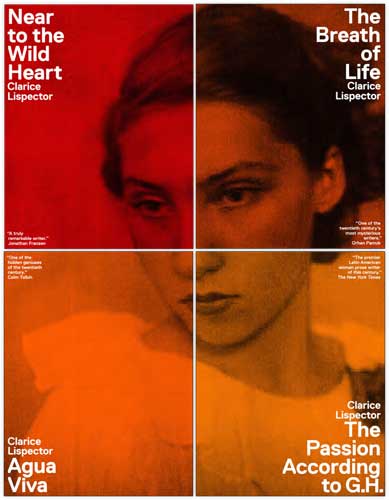
The next 4 newly translated volumes
to be published, which
will form a portrait of
Lispector when placed together
From Moser's postscript and from the front matter it appears that New Directions will be publishing new translations of several more of the books, which Craig Morgan Teicher's September 27, 2011 article in Publishers Weekly confirms. New Directions will issue new translations of Lispector's highly praised début, Near to the Wild Heart; The Passion According to G. H., Lispector's greatest existential and spiritual exploration; A Breath of Life (Um sopra de vida: pulsações, her last, posthumous, highly abstract, metafictional book, which has not been translated into English); and Água Viva, which Elizabeth Lowe and Earl Fitz translated as The Stream of Life, and published with University of Minnesota Press in 1989. Hélène Cixous, who brought worldwide attention to Lispector, wrote the introduction this earlier version; I wonder who New Directions will get to introduce it. Thank you, New Directions, and, as with Murakami's tome, when these appear, if I have the scratch, I will be getting them, and urging the university and other local libraries to do so as well. Fellow readers and teachers, take note!

From Moser's "Translator's Afterword" (p. 80):

Clarice Lispector's weird word choices, strange syntax, and lack of interest in conventional grammar produces [sic] sentences--often fragments of sentences--that veer towards abstraction without ever quite reaching it. her goal, mystical as well as artistic, was to rearrange conventional language to find meaning, but never to discard it completely. 
Paradoxically, the better one's Portuguese, the more difficult it is to read Clarice Lispector. The foreigner with a basic knowledge of Romance grammar and vocabulary can read The Hour of the Star with ease. The Brazilian, however, often finds her extremely difficult. This is because her subtle rearrangements of everyday language are so surprising that they often baffle the reader, particularly the reader with little experience of her work. 

And from his new translation, here is the narrator, the often strange, sometimes repellent, always beguiling Rodrigo S. M., describing the novel's protagonist, heartbreaking, hapless Macabéa (p. 29):

She had what's known as inner life and didn't know it. She lived off herself as if eating her own entrails. When she went to work she looked like a gentle lunatic because as the bus went along she daydreamed in loud and dazzling dreams. These dreams, because of all that interiority, were empty because they lacked the essential nucleus of--of ecstasy, let's say. Most of the time she had without realizing it the void that fills the souls of the saints. Was she a saint? So it seems. She didn't know that she was meditating because she didn't know what the word meant. But it seems to me that her life was a long meditation on the nothing. Except she needed others in order to believe in herself, otherwise shed'd get lost in the successive and round emptinesses inside her. She meditated while she was typing and that's why she made even more mistakes.

There's so much more. From Copyright © Clarice Lispector, The Hour of the Star translated from the Portuguese by Benjamin Moser, New York: New Directions Publishing Corporation, 1977, 2011. Translation Copyright © Benjamin Moser, 2011.
Read More
Posted in Benjamin Moser, Brazilian literature, Clarice Lispector, fiction, Haruki Murakami, Japanese literature, New Directions, novel, translation | No comments

Wednesday, 24 August 2011

Borges' Birthday + Poem/Translation: Borges

Posted on 19:38 by Unknown

Today would be the 112th birthday of Jorge Luis Borges (1899-1986), the poet, fiction writer, essayist, and aesthete, who was without a doubt one of Argentina's and Latin America's greatest gifts to the world of arts and letters.  I tend to think of Borges as a fiction writer, since it was through the genre that I first encountered his work, and it was as an innovator in the short fictional form that his global reputation took hold, but he began his writing career in his native country and, I think it's fair to say, thought of himself primarily as a poet. He was a very good one, sometimes an exceptional one. As he wrote in his poem "Inscripcíon" (Inscription), in the posthumous collection "Los conjurados" (The conjured ones), "Escribir un poema es ensayar una magia menor" (To write a poem is to attempt a minor magic.)  I should note that Borges is one of those writers (like Wallace Stevens, for example) whose politics and personal beliefs I disagree with, but whose work I nevertheless have a great affinity for.  His poetry in particular has grown on me as I have gotten older.  In honor of Borges' birthday, I am posting a few links to articles on him, and one of his late poems that I love, as it captures the simplicity, rhetorical skill, and evocative power that at his best he would often pack into the shorter poems he wrote towards the end of his life.

The links:
Christian Science Monitor: "Jorge Luis Borges: What Made Him So Good?"
Guardian Online: "Jorge Luis Borges' Google doodle celebrates the master of magical realism"
El Clarín (One of Argentina's major newspapers): "Hoy Borges cumpliría 112 y se los festejan"

The poem:
"El cómplice" (The Accomplice), from La cifra (The Limit) (1981) needs little explanation. It is also simple enough for me to translate, and all the faults in the English are mine, but if you can read it aloud in the Spanish, you also will get more of Borges' original music, the repetition of the "c" sounds in the first line, for example, or the sustained grammatical and syntactic repetitions of the first four lines, which he reverses in the fifth, shifting the speaker's agency from response to the head of the sentence, after he has endured a series of trials, including hell/the inferno.

EL CÓMPLICE

Me crucifican y yo debo ser la cruz y los clavos.
Me tienden la copa y yo debo ser la cicuta.
Me engañan y y debo ser la mentira.
Me inciendan y yo debo ser el infierno.
Debo alabar y agradecer cada instante del tiempo.
Mi alimento es todas las cosas.
El peso preciso del universo, la humillación, el júbilo.
Debo justificar lo que hiere.
No importa mi ventura o mi desventura.
Soy el poeta.

THE ACCOMPLICE

They crucify me and I must be the cross and the nails.
They hand me the cup and I must be the hemlock.
They fool me and I must be the lie.
They set me on fire and I must be the inferno.
I have to praise and thank every instant of time.
Everything nourishes me.
The precise weight of the universe, humiliation, jubilation.
I must justify what wounds me.
My fortune or misfortune is of no importance.
I am the poet.

Copyright © Jorge Luis Borges, from La cifra (1981; Emece Editores, 1993). Translation © John Keene, 2011.
Read More
Posted in Argentina, Jorge Luis Borges, Latin American poetry, poem, poetry, Spanish-language poetry, translation | No comments
Older Posts Home
Subscribe to: Posts (Atom)

Popular Posts

  • Russian Writers Lead Protest Walk + Daniel Sada's Almost Never
    Boris Akunin (© RIA Novosti. Ilia Pitalev) "[Writers are] engineers of the human soul." I'd never read this quote before, and ...
  • Bill de Blasio's Victory (& Secret Weapon)
    Dante, Chiara, Bill and Chirlane de Blasio (© David Handschuh, New York Daily News ) Below I've posted bit of silliness from one of my l...
  • Obama Again Supports Marriage Equality + NC Again Denies Equal Rights + Garry Wills on the Myth of Marriage
    A busy week, with a big deadline, so these posts will be brief. I was very glad to see President Barack Obama cease his seesawing and final...
  • Thinking About the MLA, Queer Theory, Literary Study
    I described this quarter's movement thus far--it's been only one week and had I followed the suggested teaching schedule I would hav...
  • Trane's LI House Needs $ + Roscoe Mitchell, Hidden Chi Treasure
    Are you a music fan? A rich one? Or one blessed with carpentry and masonry skills?  Rich and skilled enough to help restore and preserve a r...
  • Poem: Ronaldo V. Wilson
    "This is a song for the genius child." - Langston Hughes Hughes was incontestably a genius, as is Ronaldo V. Wilson . (But his sou...
  • Book Reviews in Drunken Boat + The Chronicle Attack on Black Studies Grad Students
    I often forget to post little things I've done or have been up to, but: the online (and print) journal Drunken Boat has published my re...
  • Remembering Carlos Fuentes & Christine Brooke-Rose
    Carlos Fuentes, at home in Mexico, 2001 (Henry Romero/Reuters) In the mid-1980s, Carlos Fuentes (1928-2011) was at the height of his fame....
  • End-of-Week Roundup + Memories of Chekhov
    A girl holds a South Sudan flag with stripes symbolising the people, their blood and the land. Photograph: Ho/Reuters After decades of war, ...
  • Random Photos
    Much writing of late, though unfortunately little here. More soon. In lieu of, photos. Man cutting durian fruit for sale on the street, Lowe...

Categories

  • "'like' culture" (1)
  • 1960s (1)
  • 1966 (1)
  • 1970s (3)
  • 1980s (6)
  • 1990s (2)
  • 19th century (3)
  • 2012 (1)
  • 2012 election (3)
  • 2012 Olympics (1)
  • 2013 (2)
  • 2016 Olympics (1)
  • 20th century (3)
  • 4th of July (1)
  • 9/11 (2)
  • A Bolha Editora (1)
  • A. Philip Randolph (1)
  • Aaron Shurin (1)
  • Aaron Swartz (1)
  • Abdellah Taïa (1)
  • Abdias do Nascimento (1)
  • Abraham Lincoln (1)
  • abstract art (5)
  • abstraction (2)
  • academe (3)
  • academic journals (1)
  • academics (1)
  • Academy of American Poets (2)
  • acorn squash (1)
  • acting (1)
  • activism (7)
  • Adam Johnson (1)
  • Adam Pendleton (1)
  • Adbusters (2)
  • Adélia Prado (1)
  • Adeline Koh (1)
  • Adepero Oduye (1)
  • Adrian M. S. Piper (1)
  • Adrienne Klein (1)
  • Adrienne Rich (1)
  • Adunis (2)
  • aesthetics (1)
  • affirmative action (2)
  • Afghan poetry (1)
  • Afghanistan (2)
  • Afghanistan War (1)
  • africa (6)
  • African American art (1)
  • African American history (3)
  • african american literature (10)
  • African American music (2)
  • african american poetry (20)
  • African American Studies (5)
  • African Americans (16)
  • African Diaspora (6)
  • African Diasporic writing (2)
  • African literature (2)
  • African music (1)
  • African Poetry Book Series (1)
  • African writing (1)
  • Afro-Brazilians (4)
  • Afro-Latin (1)
  • Afro-Latin literature (1)
  • Afro-Latin people (4)
  • Afrolatinos (3)
  • Ai (1)
  • Ai Weiwei (1)
  • AIDS (1)
  • Akilah Oliver (2)
  • Al Qaeda (1)
  • Alain Ménil (1)
  • Alban Berg (1)
  • Albert Ayler (1)
  • Albert Pujols (4)
  • Aldon Nielsen (1)
  • Alexander Kluge (2)
  • Alexander McQueen (1)
  • Alexander Nazaryan (1)
  • Alice Yard (1)
  • All Blacks (2)
  • Alphonso Lingis (1)
  • ambiguity (1)
  • Amendment One (1)
  • America (3)
  • American (2)
  • American Academy of Arts and Letters (1)
  • American art (3)
  • American fiction (3)
  • American history (2)
  • American literature (8)
  • American Literature Association (1)
  • American music (1)
  • american poetry (28)
  • American writers (1)
  • Americas (1)
  • Amy Lowell (1)
  • Amy Winehouse (1)
  • Ana Cristina Cesar (1)
  • Anaheim (1)
  • analysis (1)
  • analytical fiction (1)
  • Anderson Cooper (1)
  • André Breton (1)
  • André Derain (1)
  • André Watts (1)
  • Andrea Lunsford (1)
  • Andrei Levkin (1)
  • Andres Serrano (1)
  • Andrew Blackley (1)
  • Andrew Cuomo (2)
  • Andy Mister (1)
  • Andy Warhol (1)
  • Angela Carter (1)
  • Anglophone Africa (1)
  • Anglophone literature (1)
  • animation (1)
  • Ann Dunham (1)
  • Ann Hamilton (1)
  • Ann Lauterbach (1)
  • Ann Patchett (1)
  • Anna Deeny (1)
  • Anna Olga Brown (1)
  • Anne Carson (1)
  • Annie Murphy Paul (1)
  • anniversary (1)
  • Anonymous (1)
  • anthology (1)
  • anti-gay (1)
  • anti-poverty (1)
  • anti-racism (1)
  • anti-sodomy (1)
  • Antilles (1)
  • antiwar protests (1)
  • Anton Chekhov (2)
  • Antoni Gaudí (2)
  • Antoni Tàpies (1)
  • aphorism (1)
  • apocalypse (1)
  • app (3)
  • Apple (1)
  • Arab American poetry (2)
  • Arab cultures (1)
  • Arab world (4)
  • Arabic (1)
  • Arabic fiction (1)
  • Arabic literature (1)
  • Arc de Triomf (1)
  • architecture (3)
  • archive (4)
  • Archivo F.X. (1)
  • Argentina (2)
  • Argentinian literature (1)
  • Armond White (1)
  • Arnold Schoenberg (1)
  • art (48)
  • art criticism (1)
  • art exhibit (4)
  • Art Expo 2013 (1)
  • art film (2)
  • art history (1)
  • Art Institute of Chicago (1)
  • art museum (1)
  • art music (4)
  • Arthur Rimbaud (1)
  • artistic gymnastics (2)
  • arts (1)
  • Ashford and Simpson (1)
  • Asia Society (1)
  • Asian American athletes (1)
  • Asian American literature (1)
  • Asian American poetry (6)
  • Asian Americans (1)
  • Asian poetry (1)
  • assemblage (1)
  • association (1)
  • atheism (1)
  • athletes (1)
  • athletics (1)
  • austerity (2)
  • austerity bomb (2)
  • Australia (2)
  • Australian literature (1)
  • authors (1)
  • automat (1)
  • avant (1)
  • avant-garde (5)
  • awards (1)
  • AWP (4)
  • Ayn Rand (2)
  • Back Bay (1)
  • Bakare Gbadamosi (1)
  • Balthus (1)
  • Baltimore (1)
  • Baltimore Orioles (1)
  • bankruptcy (1)
  • Barack Obama (23)
  • Barcelona (5)
  • Barkley L. Hendricks (1)
  • baseball (6)
  • Basho (1)
  • basketball (3)
  • Bayard Rustin (1)
  • Baz Luhrman (1)
  • BEA (1)
  • Beacon Hill (1)
  • bears (1)
  • Beat Poets (1)
  • beauty (3)
  • Belle da Costa Greene (1)
  • Ben Vinson (1)
  • Benjamin Moser (1)
  • Berlin (2)
  • Betsy Wing (1)
  • Bette Davis (1)
  • Betty Ford (1)
  • Beyonce (1)
  • Big 10 (1)
  • Big Brother Brazil (1)
  • big-box (1)
  • Bill Clegg (1)
  • Bill Clinton (1)
  • Bill de Blasio (1)
  • Bill Thompson (1)
  • Billy Collins (1)
  • Binyavanga Wainaina (1)
  • biography (1)
  • biology (1)
  • biopower (1)
  • birthday (4)
  • black academics (1)
  • black actors (1)
  • black art (7)
  • black art. (1)
  • Black Arts Movement (4)
  • black culture (2)
  • black dandy (1)
  • black gay (2)
  • black history (2)
  • Black History Month (4)
  • black LGBTQ (11)
  • black liberation (1)
  • black literature (2)
  • black men (1)
  • Black Mountain school (1)
  • black music (2)
  • black people (3)
  • black poetics (1)
  • black poetry (2)
  • black surrealism (1)
  • black women (2)
  • black writing (6)
  • blackness (1)
  • Block Museum of Art (1)
  • blogging (5)
  • blogiversary (2)
  • Bloomsday (2)
  • blue (1)
  • blues (1)
  • Bob Marley (1)
  • bodies (1)
  • bohemian (1)
  • Book Expo America (1)
  • book reviews (1)
  • books (15)
  • bookselling (1)
  • bookshelf (1)
  • bookstore (1)
  • bookstores (1)
  • Borders (2)
  • Boris Akunin (1)
  • Boris Pasternak (1)
  • Boston (6)
  • Boston Marathon (1)
  • brain science (3)
  • Brasília (2)
  • bravery (1)
  • brazil (16)
  • Brazilian literature (4)
  • Brazilian poetry (5)
  • Brent Hayes Edwards (1)
  • British (1)
  • British literature (2)
  • British poetry (1)
  • Bronx (3)
  • Brooklyn (4)
  • Brooklyn Museum (1)
  • Bruno Carvalho (1)
  • Buddhism (1)
  • budget cuts (1)
  • Busboys and Poets (1)
  • butterflies (1)
  • C's Holiday Kitchen (1)
  • CAC Digital Arts (2)
  • cafe (1)
  • cake (2)
  • California (5)
  • Camille T. Dungy (1)
  • campaign (1)
  • campesino (1)
  • Canada (1)
  • Canadian film (1)
  • Canadian poetry (1)
  • Cape Verde (1)
  • capital punishment (1)
  • capitalism (1)
  • Caribbean (2)
  • Caribbean art (1)
  • Caribbean music (1)
  • Caribbean poetry (2)
  • Caribbean writing (2)
  • Carl Phillips (1)
  • Carl Sandburg (2)
  • Carlos Fuentes (1)
  • Carlos Skliar (2)
  • Carmen Herrera (1)
  • Carnaval (2)
  • Carnival (1)
  • Carter G. Woodson (1)
  • Catalonia (1)
  • catastrophe (1)
  • cathedral (1)
  • Catherine Barnett (1)
  • Cathy Davidson (1)
  • Cave Canem (3)
  • Cecil Taylor (1)
  • celebration (2)
  • censorship (1)
  • census (1)
  • centenarian (1)
  • Cervantes Prize (1)
  • César Aira (1)
  • Cesária Évora (1)
  • chamber music (1)
  • championship (1)
  • chancellor (1)
  • chapbook (2)
  • Chapbook Festival (1)
  • Charles Baudelaire (1)
  • Charles Ives (1)
  • Charles Rice-González (1)
  • Charles Yu (1)
  • Cheim & Read (1)
  • Chelsea (3)
  • chemistry (1)
  • Chester Himes (1)
  • chicago (27)
  • Chicago Book Expo (1)
  • Chicago Poetry Project (1)
  • Chicago Writers' House (1)
  • Chicano poetry (3)
  • Chile (3)
  • Chilean poetry (4)
  • China (3)
  • Chinese Americans (1)
  • Chinese literature (1)
  • Chinese writing (1)
  • chocolate (1)
  • Chris Carpenter (1)
  • Chris Christie (1)
  • Christchurch (1)
  • Christian Bök (1)
  • Christian Marclay (1)
  • Christine Brooke-Rose (1)
  • Christine Quinn (1)
  • Christine Smallwood (1)
  • Christmas (2)
  • Christopher Cozier (1)
  • Christopher Hitchens (1)
  • Christopher Stackhouse (2)
  • Chronicle of Higher Education (3)
  • Chulito (1)
  • cinema (5)
  • City Lights Books (1)
  • civil liberties (1)
  • civil rights (1)
  • Civil War (1)
  • Claire Denis (1)
  • Clarice Lispector (2)
  • class (1)
  • class struggle (1)
  • classes (1)
  • classical music (4)
  • classics (2)
  • Claude McKay (1)
  • Claudia Rankine (2)
  • Claudia Roquette-Pinto (2)
  • clerihew (1)
  • Cleveland (1)
  • Clifton Gachagua (1)
  • climate change (1)
  • Clint Eastwood (1)
  • clothing (1)
  • cloud (1)
  • codex (1)
  • cognitive linguistics (2)
  • cognitive psychology (4)
  • cognitive science (5)
  • Colin Powell (1)
  • collaboration (1)
  • collapse (1)
  • Colm Toibín (1)
  • Colombia (3)
  • Colombian poetry (1)
  • colonialism (2)
  • color (1)
  • color of change (1)
  • Colorado (1)
  • ColorOfChange.org (1)
  • Columbia University (2)
  • comedy (4)
  • comics (1)
  • coming out (2)
  • Common (1)
  • common words (1)
  • communism (2)
  • community (1)
  • commuting (2)
  • comparative literature (1)
  • computers (1)
  • conceptual art (6)
  • concision (1)
  • conference (4)
  • Congress (3)
  • Connecticut (1)
  • conservatism (2)
  • contemporary art (2)
  • controversy (2)
  • conversation (1)
  • cooking (1)
  • Cooper Union (2)
  • Copley Square (1)
  • Cornell University (1)
  • corporeality (1)
  • Cory Arcangel (1)
  • Cory Booker (1)
  • Countee Cullen (1)
  • couplets (1)
  • courage (2)
  • creative nonfiction (1)
  • creative writing (3)
  • creativity (2)
  • Crispus Attucks (1)
  • criticism (9)
  • critique (3)
  • cross-cultural imagination (1)
  • cuba (1)
  • Cuban American (1)
  • Cuban painting (1)
  • cuisine (1)
  • cultural studies (1)
  • culture (2)
  • CUNY (4)
  • curator (1)
  • curry (1)
  • Curtis Allen (1)
  • Cy Twombly (1)
  • cycling (1)
  • Czech Republic (1)
  • D21 Kunstraum (1)
  • DADT (2)
  • DADT Repeal (4)
  • Damien Hirst (1)
  • dance (5)
  • dancing (1)
  • dandyism (1)
  • Daniel Barenboim (1)
  • Daniel Sada (1)
  • Dark Room Writers Collective (7)
  • Daron Acemoglu (1)
  • Data Garden (1)
  • David Belle (1)
  • David Freese (1)
  • David Hockney (2)
  • David Kato (1)
  • David Moore (1)
  • David Wojnarowicz (1)
  • death penalty (1)
  • debt-limit ceiling (1)
  • Dee Rees (1)
  • delicious food (1)
  • dementia (1)
  • democracy (1)
  • Democratic National Convention (1)
  • Democratic Party (1)
  • Democrats (4)
  • Denis Villeneuve (1)
  • Denise Levertov (1)
  • Denver (1)
  • Derek Jeter (1)
  • Derrick Bell (1)
  • development (1)
  • Diedre L. Murray (1)
  • difficulty (2)
  • digital humanities (1)
  • digital library (2)
  • digital literature (1)
  • digital music (1)
  • Digital Public Library of America (1)
  • digitization (3)
  • Dilma Rousseff (1)
  • disaster (1)
  • disco (1)
  • Discovering Columbus (1)
  • dissent (2)
  • dissident writing (1)
  • DNA (1)
  • Dodge Poetry Festival (1)
  • DOMA (3)
  • domestic workers (1)
  • dominican republic (6)
  • Don Lemon (1)
  • Donna Summer (1)
  • downloading (1)
  • DPLA (1)
  • draft poetry (1)
  • drama (2)
  • dramaturgy (1)
  • drawing (8)
  • drawing illustration (1)
  • drawings (3)
  • Drinking Gourd Chapbook Poetry Series (2)
  • driving (3)
  • Dublin (1)
  • Dubose Heyward (1)
  • Duke University (1)
  • DUMBO (1)
  • Dutch (1)
  • e-books (6)
  • E. L. Doctorow (1)
  • earthquake (3)
  • East Africa (1)
  • East River (1)
  • East Village (1)
  • Easy Art Salon (1)
  • eating (1)
  • ebook (1)
  • ECB (1)
  • economics (16)
  • Ed Roberson (2)
  • Edgar Degas (1)
  • editing (1)
  • Edmond Jabès (1)
  • Edouard Glissant (1)
  • Édouard Glissant (2)
  • Eduardo C. Corral (1)
  • education (2)
  • Edward Field (1)
  • Edward Said (1)
  • Edwin Thumboo (1)
  • Egypt (3)
  • Egyptian women's writing (1)
  • election (2)
  • elections (1)
  • elites (1)
  • Elizabeth Alexander (2)
  • Elizabeth Catlett (1)
  • Ellen Stewart (1)
  • Elliott Carter (2)
  • Elsa Dorfman (1)
  • Emancipation Proclamation (1)
  • embodied cognition (2)
  • embodied practice (1)
  • embodiment (1)
  • Emily Dickinson (1)
  • Emily Prince (1)
  • emotion (1)
  • Emotional Outreach Project (2)
  • empire (1)
  • Empire State Building (1)
  • Encyclopedia (2)
  • end of the quarter (1)
  • England (1)
  • English (1)
  • English literature (1)
  • English Renaissance (1)
  • enlightenment (1)
  • Enrique Vila-Matas (2)
  • entomology (1)
  • environment (1)
  • environmentalism (1)
  • Equality (3)
  • erasure poetry (1)
  • Eric Kandel (1)
  • Erica Doyle (1)
  • Ernesto Rashaad Green (1)
  • Esai Morales (1)
  • essay (3)
  • essays (1)
  • Essex Hemphill (1)
  • ethics (1)
  • ethnicity (2)
  • etymology (1)
  • Euro 2012 (1)
  • Europe (1)
  • European Community (1)
  • European literature (2)
  • Eurozone (1)
  • Evanston (2)
  • Ewan Morrison (1)
  • exam week (1)
  • execution (1)
  • exhibit (1)
  • exile (1)
  • experimental cinema (2)
  • experimental music (1)
  • experimental poetry (2)
  • experimentalism (4)
  • Exterface (1)
  • F. Scott Fitzgerald (1)
  • faculty (1)
  • fantasy (2)
  • fascism (1)
  • fashion (4)
  • Fashion Week (1)
  • favelas (1)
  • Federal Reserve (1)
  • Federico García Lorca (1)
  • fellowships (1)
  • feminism (2)
  • feminities (1)
  • fiction (26)
  • fiction writing (7)
  • Field Research Study Group A (1)
  • FIFA Women's Soccer World Cup (1)
  • figuration (1)
  • figurative painting (1)
  • film (6)
  • films (2)
  • finance (2)
  • fiscal cliff (2)
  • fitness (1)
  • flanerie (19)
  • flash fiction (1)
  • Flesch-Kincaid test (1)
  • flora (1)
  • Florida (2)
  • flowers (3)
  • Flowers of Evil (1)
  • Foldit (1)
  • Folger Shakespeare Library (1)
  • folktale (1)
  • food (2)
  • football (1)
  • Forrest Gander (1)
  • Fox News (1)
  • France (4)
  • Frances E. W. Harper (1)
  • Francisco Alvim (1)
  • François Hollande (1)
  • Francophone (1)
  • Frank Kameny (1)
  • Frank Lautenberg (1)
  • Frank O'Hara (1)
  • Frank Ocean (1)
  • Fred Joiner (1)
  • Frederick Douglass (1)
  • free (1)
  • free internet (1)
  • free jazz (2)
  • free running (1)
  • freedom (4)
  • Freedom Budget (1)
  • French literature (1)
  • French movies (1)
  • French poetry (3)
  • fruits (1)
  • Fukushima reactor (1)
  • fun (1)
  • funding (1)
  • future (1)
  • future of writing (1)
  • G. C. Lichtenberg (1)
  • Gabriel Garcia Marquez (1)
  • Gabrielle Giffords (1)
  • galleries (1)
  • Ganzfeld effect (1)
  • Gardening (1)
  • Garry Wills (1)
  • Gary Simmons (1)
  • Gary Snyder (1)
  • Gavin Brown (1)
  • Gawker (1)
  • gay (2)
  • gay equality (1)
  • Gay liberation (2)
  • gay marriage (1)
  • gay rights (1)
  • gender (2)
  • Gene Sharp (1)
  • General Assembly (1)
  • Generation X (1)
  • genetics (1)
  • genius (3)
  • Genius awards (1)
  • gentrification (2)
  • George Dureau (1)
  • George Gershwin (1)
  • George Lakoff (1)
  • George W. Bush (2)
  • George Zimmerman (1)
  • geosynchronies (1)
  • Geraldine R. Dodge Foundation (1)
  • Gerhard Richter (1)
  • German (1)
  • German literature (3)
  • German poetry (2)
  • German-language literature (1)
  • Germany (5)
  • Gertrude Vanderbilt Whitney (1)
  • Gillette Four Nations (1)
  • giovanni singleton (2)
  • Glenn Ligon (2)
  • global literature (2)
  • globalism (1)
  • globalization (1)
  • Goldie Goldbloom (1)
  • Google (2)
  • GOP (2)
  • gospel (1)
  • government (1)
  • graduation (1)
  • graffiti (2)
  • Grant Park (1)
  • Great Britain (3)
  • Great Migration (1)
  • Greece (1)
  • Greek (1)
  • green politics (1)
  • Greenwich Village (1)
  • Greg Bordowitz (1)
  • Greg Tate (1)
  • grief (1)
  • Guggenheim Museum (1)
  • Guild Complex (1)
  • Gun Hill Road (1)
  • Gustav Klimt (1)
  • Guy-Mark Foster (1)
  • gymnastics (1)
  • hacktivism (1)
  • haiku (1)
  • Haiti (2)
  • Hall of Fame (1)
  • Halloween (1)
  • Hampton University (1)
  • Hanukkah (1)
  • Happy Holidays (2)
  • Happy New Year (4)
  • Harlem (5)
  • Harlem Book Fair (2)
  • Harlem Renaissance (1)
  • Harmony Santana (1)
  • Harryette Mullen (1)
  • Haruki Murakami (2)
  • Harvard (4)
  • Harvard Law School (1)
  • HathiTrust (1)
  • Haymarket Affair (1)
  • HBCU (1)
  • health care reform (1)
  • Helen Frankenthaler (1)
  • Helen Vendler (1)
  • Hennessy Youngman (1)
  • Henry James (1)
  • Henry Louis Gates Jr. (3)
  • herbs (1)
  • Herta Müller (1)
  • heteronormativity (1)
  • heterosexism (2)
  • High Line Park (1)
  • higher education (2)
  • Hilda Hilst (7)
  • hip hop (3)
  • Hispaniola (1)
  • Hispanophone literature (1)
  • historian (1)
  • history (29)
  • HIV/AIDS (5)
  • Hoboken (1)
  • hodgepodge (1)
  • holidays (2)
  • Hollywood (2)
  • homonormativity (1)
  • homophobia (3)
  • homosexuality (1)
  • House (1)
  • Houston (1)
  • Human Micropoem (2)
  • humor (3)
  • Hungarian literature (1)
  • hurricane (2)
  • Hurricane Irene (2)
  • Hurricane Sandy (3)
  • ice (1)
  • IDAHO (2)
  • ideas (2)
  • identification (1)
  • identity (1)
  • illustration (1)
  • Ilya Kutik (2)
  • image (1)
  • imagery (1)
  • imaginary maps (1)
  • Imagism (1)
  • immigrant (1)
  • immigration (1)
  • impressions (1)
  • improvisation (1)
  • inaugural poet (2)
  • inauguration (1)
  • Incendies (1)
  • independence day (1)
  • independent cinema (1)
  • indigenous cultures (1)
  • inequality (2)
  • injustice (1)
  • innovative writing (1)
  • installation (2)
  • installation art (1)
  • intellectual (1)
  • International Day Against Homophobia and Transphobia (1)
  • international poetry (5)
  • international poetry month (6)
  • international writing (1)
  • Internet (5)
  • iPad (5)
  • iPhone (10)
  • Ira Gershwin (1)
  • Iraq (1)
  • Iraq War (3)
  • Ireland (1)
  • Irish (1)
  • Irish literature (1)
  • irony (1)
  • Isaac Julien (1)
  • Isabel Wilkerson (1)
  • Ishmael Reed (2)
  • Islam poetry (1)
  • Israel (1)
  • It Gets Better (1)
  • Italy (1)
  • J. P. Morgan (1)
  • Jack Spicer (1)
  • Jakob Jensen (1)
  • Jamaica (2)
  • James Baldwin (1)
  • James Fenton (1)
  • James Joyce (3)
  • James Laughlin (1)
  • James Richardson (1)
  • James Schuyler (1)
  • James Shapiro (1)
  • James Turrell (1)
  • Jane Austen (1)
  • Jane Brox (2)
  • Janny Scott (1)
  • Japan (1)
  • Japanese literature (1)
  • Jaron Lanier (4)
  • Jason Collins (1)
  • Javier Marías (1)
  • Jay Wright (1)
  • Jayne Cortez (1)
  • jazz (4)
  • Jean Valentine (1)
  • Jean Wyllys (1)
  • Jean-Christophe Cloutier (1)
  • Jean-Luc Godard (1)
  • Jean-Michel Basquiat (2)
  • Jeffrey Eugenides (1)
  • Jen Hofer (1)
  • Jennifer DeVere Brody (1)
  • Jennifer Egan (1)
  • Jennifer Karmin (1)
  • Jennifer Scappettone (2)
  • Jeremiah Moss (2)
  • Jeremy Lin (1)
  • jersey city (25)
  • Jesmyn Ward (1)
  • Jewish American writers (1)
  • Jewish writers (3)
  • Jill Biden (1)
  • Jim Baital (1)
  • Jim Goodman (1)
  • Joaquim Barbosa (1)
  • Joe Biden (1)
  • John Ashbery (3)
  • John Cage (1)
  • John Chamberlain (1)
  • John Coltrane (1)
  • John Donne (1)
  • John Florio (1)
  • John Lawrence (1)
  • John Roberts Jr. (1)
  • Jonas Mekas (1)
  • Jonathan Galassi (1)
  • Jorge Carrera Andrade (1)
  • Jorge Frisancho (1)
  • Jorge Luis Borges (1)
  • José Celso Barbosa (1)
  • José Reyes (3)
  • Joseph Biden (1)
  • Joseph Stalin (1)
  • Josh Dixon (1)
  • Joshua Marie Wilkinson (1)
  • Juan Dicent (1)
  • Juan Diego Tamayo (1)
  • Juan Felipe Herrera (2)
  • Juan Rodríguez (1)
  • Juan Rulfo (1)
  • Juan Vico (1)
  • Judy Reyes (1)
  • Juna Vico (1)
  • June Jordan (1)
  • junot díaz (1)
  • Juscelino Kubitschek (1)
  • Justin Torres (1)
  • Kamau Brathwaite (2)
  • Kamran Mir Hazar (1)
  • Kansas (1)
  • Kanye West (1)
  • Kate Daniels (2)
  • Kathy Westwater (1)
  • Kenneth Fearing (1)
  • Kenneth Goldsmith (1)
  • Kenneth Koch (2)
  • Kenning Editions (1)
  • Kenya (2)
  • Keorapetse Kgositsile (2)
  • Kevin Jerome Everson (1)
  • knowledge (1)
  • Kofi Anyidoho (1)
  • Kristiana Rae Colón (2)
  • Kwame Dawes (3)
  • Kwanzaa (2)
  • Kynaston McShine (1)
  • La MaMa e.t.c. (1)
  • labor (4)
  • Labor Day (1)
  • Ladbrokes (1)
  • land-use law (1)
  • Langston Hughes (6)
  • language (4)
  • Larissa Volokhonsky (1)
  • Larry Bartels (1)
  • Larry Sawyer (1)
  • Laszló Krasznahorkai (1)
  • Latin (1)
  • latin america (2)
  • Latin American literature (3)
  • Latin American poetry (6)
  • Latino (3)
  • Latino art (1)
  • Latino literature (1)
  • Latino poetry (4)
  • Latinos (2)
  • Laura Hartmark (1)
  • law (2)
  • Lawrence Lessig (1)
  • Lawrence v. Texas (1)
  • learning (1)
  • leave-taking (1)
  • lecture (1)
  • Lee Drutman (1)
  • Left (4)
  • legal systems (1)
  • Leipzig (1)
  • LentSpace (1)
  • Leon Panetta (1)
  • Leonard Bernstein (1)
  • lesbians (4)
  • letters (3)
  • LGBT (2)
  • LGBTIQ (5)
  • LGBTIQ art (3)
  • lgbtiq literature (2)
  • lgbtiq writing (6)
  • LGBTQ (30)
  • LGBTQ Pride (2)
  • lgbtq writing (6)
  • lgbtqi youth (1)
  • Li-Young Lee (1)
  • liberalism (2)
  • liberals (1)
  • liberation (1)
  • libertarianism (1)
  • liberty (1)
  • libraries (3)
  • library (1)
  • life (2)
  • life drawings (1)
  • light (2)
  • light rail (2)
  • Lincoln Center (1)
  • Linda Hogan (1)
  • literary agents (1)
  • literary studies (1)
  • literary study (1)
  • literature (66)
  • lockout (1)
  • London Olympics (2)
  • Long Island (1)
  • Lorna Dee Cervantes (1)
  • Los Angeles (5)
  • Los Angeles Angels (1)
  • loss (1)
  • Lower East Side (1)
  • Lubna Azabal (1)
  • Lucian Freud (1)
  • Luis Alberto Urrea (1)
  • lunch (1)
  • luncheon (1)
  • lyric (2)
  • lyric poetry (1)
  • MA/MFA program (1)
  • MacArthur Foundation (1)
  • Macintosh (1)
  • Maggie da Silva (2)
  • Maja Djikic (1)
  • Major Jackson (1)
  • Major League Baseball (1)
  • Malcolm Gladwell (1)
  • Malcolm X (1)
  • Man Booker International prize (1)
  • Manhattan (4)
  • Manning Marable (1)
  • Maori (1)
  • maps (1)
  • Marc Bamuthi Joseph (1)
  • Marcel Proust (1)
  • Marcellus Blount (1)
  • march (1)
  • Mardi Gras (1)
  • Margaret Porter Troupe (1)
  • Marianne Moore (1)
  • Marina Abramovic (1)
  • marinara sauce (1)
  • Mark Anthony Neal (1)
  • Mark Bradford (1)
  • Mark Carson (1)
  • Mark Duggan (1)
  • marriage equality (1)
  • Martha Collins (1)
  • Martin Heidegger (1)
  • Martin Luther King Jr. (4)
  • Marvin Lee Wilson (1)
  • Marxism (2)
  • Mary Ruefle (1)
  • Maryemma Graham (1)
  • masculinities (1)
  • masculinity (1)
  • mathematics (1)
  • May Day (1)
  • mayor (1)
  • Medgar Evers College (1)
  • media (1)
  • Mel Edwards (1)
  • Mellon Foundation (1)
  • melodrama (1)
  • Melvin Van Peebles (1)
  • memorial (2)
  • Memorial Day (2)
  • memoriam (1)
  • memory (4)
  • Mendi + Keith Obadike (1)
  • Merce Cunningham (1)
  • Merkozy (1)
  • Meryl Streep (1)
  • Mesea (3)
  • metaphor (4)
  • metarealism (1)
  • Metropolitan Museum of Art (1)
  • Metropolitan Opera (1)
  • Mexican literature (2)
  • Mexican poetry (2)
  • Mexico (2)
  • MFA (2)
  • MFA program (2)
  • Miami Marlins (1)
  • Michael Agger (1)
  • Michael Bloomberg (1)
  • Michael Cunningham (1)
  • Michael Musto (1)
  • Michelle Obama (3)
  • Mickalene Thomas (2)
  • microeconomy (1)
  • microfiction (1)
  • micrograms (1)
  • Middle East (2)
  • Midtown (1)
  • Mike Bloomberg (2)
  • military (4)
  • mind (1)
  • Miriam Pace (1)
  • MIT (2)
  • Mitt Romney (3)
  • MLA (3)
  • MLB (4)
  • MLK Jr. Day (1)
  • Modernism (9)
  • Mohja Kahf (1)
  • MoMa (3)
  • Mona Van Duyn (1)
  • monetization (2)
  • Mordechai Noah (1)
  • Morgan Library (1)
  • morna (1)
  • Morocco (1)
  • Mothers Day (1)
  • movies (2)
  • moving (1)
  • mulatto (1)
  • multiculturalism (1)
  • murder (2)
  • Muriel Rukeyser (2)
  • museum (1)
  • music (12)
  • musical theater (1)
  • Muslims (1)
  • Myriam Moscona (1)
  • mysticism (1)
  • n+1 (1)
  • Nancy Cantor (1)
  • Naomi Shihab Nye (1)
  • Natalie Angier (1)
  • Natasha Trethewey (1)
  • Nathalie Stephens (1)
  • Nathanaël (5)
  • Nathaniel Mackey (1)
  • Nathaniel Tarn (1)
  • National Book Awards (1)
  • National Book Foundation (1)
  • national poetry month (63)
  • national security (1)
  • Native American (1)
  • Native American writing (2)
  • NATO (1)
  • natural disaster (1)
  • nature (1)
  • Nayland Blake (2)
  • NBA (3)
  • Negro (1)
  • Negro History week (1)
  • neighborhoods (1)
  • Neil Postman (1)
  • Neil Strauss (1)
  • Nelson Mandela (1)
  • neocolonialism (1)
  • neoconservatism (2)
  • neoliberalism (5)
  • neuroaesthetics (1)
  • neuroscience (3)
  • New Directions (2)
  • New England (1)
  • New Jersey (5)
  • New Year's Day (1)
  • New York (44)
  • New York Botanical Garden (1)
  • new york city (52)
  • New York Giants (1)
  • New York Knicks (1)
  • New York Mets (1)
  • New York Philharmonic (1)
  • New York Public Library (1)
  • New York School (4)
  • New York Times (4)
  • New York Yankees (3)
  • New Yorker (1)
  • New Zealand (5)
  • Newark (9)
  • Newark subway (1)
  • news (1)
  • Next Big Thing (1)
  • NFL (3)
  • Nicanor Parra (2)
  • Nicholas Carr (1)
  • Nick Ashford (1)
  • Nick Cave (1)
  • Nick Flynn (1)
  • Nicolas Bourriaud (1)
  • Nicolas Sarkozy (1)
  • Nigeria (1)
  • Nigerian poetry (1)
  • night (1)
  • Nightboat Books (1)
  • Nikki Giovanni (1)
  • Nikky Finney (1)
  • Nina Gourianova (1)
  • Noam Chomsky (1)
  • Nobel Prize (8)
  • nommo (1)
  • nonfiction (2)
  • North Africa (1)
  • North Carolina (1)
  • Northwestern (6)
  • Northwestern University (8)
  • Norway (1)
  • Nothing Personal Tour (1)
  • novel (3)
  • novella (1)
  • novels (1)
  • numerology (1)
  • Nuyorican writing (1)
  • NYPL (2)
  • NYU (7)
  • Oakland (1)
  • Obamacare (1)
  • obituaries (2)
  • obituary (6)
  • Occupy Chicago (4)
  • Occupy Together (4)
  • Occupy Wall Street (8)
  • Oceanic literature (1)
  • oculus (1)
  • Odd Future (1)
  • Olympics (1)
  • open culture (2)
  • open source (2)
  • opera (2)
  • orphan works (1)
  • Osawatomie (1)
  • Oscar Niemeyer (3)
  • Osip Mandelshtam (1)
  • Osvaldo Lamborghini (1)
  • Other Countries (1)
  • Pablo Picasso (1)
  • Pacific writing (1)
  • packing (1)
  • painting (8)
  • pajamas (1)
  • Palabra Pura (1)
  • Palestine (1)
  • Papua New Guinea (2)
  • Pariah (1)
  • Paris (4)
  • Park Avenue Armory (1)
  • parkour (1)
  • parliament (1)
  • participatory art (1)
  • Pascale Casanova (1)
  • passing (1)
  • PATH (3)
  • Patricia Grace (1)
  • Paul Celan (1)
  • Paul Krugman (3)
  • Paul Ryan (2)
  • Paul Verlaine (1)
  • Paula Ettelbrick (1)
  • Paulo Coelho (1)
  • peace (1)
  • PEN (1)
  • Penguin (1)
  • Pennsylvania (1)
  • people (1)
  • perception (1)
  • Performa (1)
  • performance (8)
  • performance art (2)
  • Peru (1)
  • petition (1)
  • Philadelphia Museum of Art (1)
  • Philip Levine (1)
  • Philip Roth (1)
  • philosophy (4)
  • photo essay (1)
  • photography (10)
  • photos (9)
  • Phyllis Diller (1)
  • Pierre Boulez (1)
  • Pierrot Lunaire (1)
  • PIPA (1)
  • Pippin Barr (1)
  • Piri Thomas (1)
  • Piss Christ (1)
  • pitching (1)
  • plants (1)
  • play (2)
  • playoffs (3)
  • plays (3)
  • playwrighting (1)
  • plutocracy (1)
  • poem (2)
  • poems (1)
  • Poesia Marginal (1)
  • Poet Laureate (3)
  • poetics (6)
  • poetry (123)
  • poetry for labor (1)
  • Poetry Foundation (1)
  • Poetry Month (32)
  • Poetry Project (1)
  • Poetry Society of America (2)
  • poets (1)
  • Poets House (5)
  • Poets Theater (1)
  • Poland (1)
  • police (3)
  • Polish poetry (1)
  • political art (1)
  • political prisoner (1)
  • political science (1)
  • politics (22)
  • polymath (1)
  • pop music (1)
  • pop-up gallery (1)
  • popular culture (1)
  • portraits (4)
  • post-colonialism (2)
  • post-Sandy (2)
  • post-WWII (1)
  • posthumanism (2)
  • postmodernism (2)
  • poverty (3)
  • power (2)
  • Prageeta Sharma (1)
  • pragmatism (1)
  • Praxis-International (1)
  • preservation (2)
  • presidency (2)
  • President Barack Obama (1)
  • presidential debate (1)
  • Presidential election (3)
  • prizes (2)
  • process-driven art (1)
  • progressive politics (8)
  • progressivism (4)
  • Prop 8 (1)
  • prose (2)
  • prose fiction (1)
  • protest (6)
  • protests (2)
  • PS1 (1)
  • psychological effects (2)
  • psychology (3)
  • PT (1)
  • public affairs (1)
  • public art (1)
  • public intellectual (3)
  • public transportation (2)
  • publishing (11)
  • Puerto Rican writing (1)
  • Puerto Rico (2)
  • Pulitzer Prize (3)
  • punk music (1)
  • Pussy Riot (1)
  • Qiu Xiaolong (1)
  • queer (18)
  • queer art (9)
  • queer studies (1)
  • Quincy Troupe (1)
  • Quintilian (1)
  • race (6)
  • Rachel Gontijo (3)
  • Rachel Levitsky (1)
  • racial profiling (1)
  • Racism (9)
  • radicalesbians (1)
  • Rahm Emanuel (1)
  • Rainer Maria Rilke (1)
  • rallies (1)
  • rally (3)
  • random photos (20)
  • random posts (2)
  • ranking (1)
  • Raphael Rubinstein (1)
  • Rastafari (1)
  • Raúl Zurita (2)
  • Ray Bradbury (1)
  • Raymond Carver (1)
  • Raymond Roussel (3)
  • reading (8)
  • reading tour (2)
  • realism (1)
  • recipe (2)
  • reconstruction (1)
  • Red Hen Press (1)
  • reelection (2)
  • reflection (1)
  • Reg Gibbons (1)
  • reggae (1)
  • Reggie Harris (4)
  • relational aesthetics (3)
  • religion (1)
  • Republican National Convention (1)
  • Republicans (3)
  • resistance (1)
  • restaurant (1)
  • reunion (1)
  • review (1)
  • revolution (2)
  • Rey Andujar (2)
  • rhetoric (2)
  • rhythm (1)
  • rhythm and blues (3)
  • Ricardo Osmondo Francis (1)
  • Richard Blanco (2)
  • Richard Iton (1)
  • Richard Nixon (1)
  • Richard Pevear (1)
  • Richard T. Greener (1)
  • Richard Wright (1)
  • right-wing (1)
  • Rigoberto González (1)
  • Rio de Janeiro (2)
  • riots (1)
  • RIP (1)
  • Rirkrit Tiravanija (2)
  • Rita Dove (3)
  • rita indiana (1)
  • ritual (1)
  • rivalries (1)
  • Robert Barchi (1)
  • Robert Darnton (2)
  • Robert Duncan (1)
  • Robert Frost (2)
  • Robert Lowell (1)
  • Robert Reid-Pharr (1)
  • Roberto Bolaño (4)
  • Roberto Sierra (1)
  • Robin Coste Lewis (1)
  • Rocinha (1)
  • Rockefeller Center (1)
  • Rod Blagojevich (1)
  • Roger Guenveur Smith (1)
  • Roman Catholicism (1)
  • Romania (1)
  • Ron Washington (1)
  • Ronald Kellogg (1)
  • Ronaldo V. Wilson (2)
  • Roosevelt Island (1)
  • Roosevelt Island Tramway (2)
  • Roscoe Mitchell (1)
  • Rosmarie Waldrop (2)
  • Rotimi Fani-Kayode (1)
  • Rowan Ricardo Phillips (1)
  • rugby (3)
  • Rugby World Cup (2)
  • Rupert Murdoch (1)
  • Rush Holt (1)
  • Russia (3)
  • Russian (1)
  • Russian book art (1)
  • Russian literature (2)
  • Russian poetry (3)
  • Rutgers Newark (5)
  • Rutgers University (4)
  • Rutgers-New Brunswick (1)
  • Rutgers-Newark (5)
  • Ryan Lizza (1)
  • Sabin Howard (1)
  • Sadakichi Hartmann (1)
  • safety net (1)
  • sagging (1)
  • Sahar Tawfiq (1)
  • Saint Louis (2)
  • Saint Louis Cardinals (4)
  • Saint Louis Rams (1)
  • Saint Patrick's Day (1)
  • sales (1)
  • salon (2)
  • Sam Rivers (1)
  • same-sex marriage (3)
  • Samuel R. Delany (1)
  • San Diego (2)
  • San Francisco (2)
  • San Francisco Renaissance (1)
  • Santo Domingo (1)
  • Santo Domingo Invita (1)
  • santorum (1)
  • Sarah Jaffe (1)
  • Sarah Schulman (1)
  • Saul Frampton (1)
  • scholar (1)
  • scholarly publishing (1)
  • scholars (1)
  • Schomburg Center (1)
  • schoolchildren (1)
  • science (1)
  • SCOTUS (4)
  • sculpture (3)
  • Seagull Books (1)
  • Sébastien Foucan (1)
  • Second Viennese School (1)
  • Seismosis (2)
  • September 11 (1)
  • sequence (1)
  • Seth Cooper (1)
  • settlers (1)
  • Seven Corners (1)
  • sexism (1)
  • sexuality (1)
  • SF (1)
  • SFF (1)
  • sgl (1)
  • Shaun El C Leonardo (1)
  • Sherwin Bryant (1)
  • Shin Yu Pai (2)
  • short stories (2)
  • short story (1)
  • Showcase (1)
  • Sigizmund Krzhizhanovsky (1)
  • Sigmund Freud (1)
  • signandsight.com (1)
  • silence (1)
  • Sillerman First Book Prize (1)
  • Simon Critchley (1)
  • Simon Keenleyside (1)
  • Simone White (1)
  • Singapore (1)
  • Sketchbook (1)
  • Sketchbook Pro (1)
  • Sketchbook Pro II (2)
  • sketches (1)
  • Slate (1)
  • slavery (2)
  • sleeper effect (1)
  • snow (2)
  • snowstorm (2)
  • soccer (3)
  • social good (1)
  • social history (1)
  • social unrest (1)
  • socialism (2)
  • Socialist Party (1)
  • society (3)
  • software (1)
  • SoHo (2)
  • Sonia Sanchez (2)
  • SOPA (1)
  • soul (2)
  • sound (2)
  • sound poetry (1)
  • South Africa (2)
  • South African literature (2)
  • South Asian American writers (1)
  • South Carolina (1)
  • South Sudan (1)
  • Soviet Union (1)
  • space (1)
  • Spain (7)
  • Spanish (3)
  • Spanish Harlem (1)
  • Spanish literature (1)
  • Spanish-language poetry (4)
  • spectacle (1)
  • speculative fiction (1)
  • spirit (1)
  • spirituality (1)
  • sports (2)
  • Sports Illustrated (1)
  • spring (3)
  • spring semester (1)
  • St. Louis (1)
  • St. Mark's Bookshop (2)
  • St. Mark's Church (1)
  • Stanford (1)
  • Stanford University (2)
  • Starving Artists Movers (1)
  • state execution (1)
  • state murder (1)
  • state power (1)
  • statehood (1)
  • states (2)
  • statistics (1)
  • Stefan Zweig (1)
  • STEM (1)
  • Stéphane Mallarmé (1)
  • Stephen Greenblatt (1)
  • Stephen Motika (1)
  • Stephen Sondheim (1)
  • Steve Fulop (1)
  • Steve Halle (1)
  • Steve Jobs (1)
  • Steven Lonegan (1)
  • Stonewall Uprising (2)
  • stop and frisk (1)
  • storm (1)
  • story (1)
  • street art (1)
  • street life (16)
  • structuralism (1)
  • Studio Museum in Harlem (1)
  • subway (1)
  • summer (4)
  • Sunlight Foundation (1)
  • surrealism (2)
  • Susan Howe (1)
  • sustainable development (1)
  • Suzan-Lori Parks (1)
  • Sweden (1)
  • Swedish Academy (1)
  • Swedish poetry (1)
  • swimming (1)
  • symbolism (2)
  • symposium (1)
  • T.S. Eliot (1)
  • tablet (1)
  • Tahrir Square (1)
  • talk (1)
  • Tampa (1)
  • Tampa Bay Rays (1)
  • Tan Lin (1)
  • Tatzu Nishi (1)
  • Tavia Nyong'o (1)
  • taxes (1)
  • Tayari Jones (1)
  • Taylor Siluwé (1)
  • teaching (15)
  • technofiction (1)
  • technology (1)
  • Teresa Sullivan (1)
  • Teri Cross Davis (1)
  • terrorism (3)
  • Terry Eagleton (1)
  • Tess Gallagher (1)
  • Texas (1)
  • Thanhha Lai (1)
  • Thanksgiving (2)
  • THATCamp Publishing (1)
  • The Center (1)
  • the crazy (1)
  • The Great Gatsby (1)
  • The Kitchen (1)
  • The Tempest (1)
  • The Waste Land (1)
  • Theaster Gates (1)
  • theater (2)
  • theory (4)
  • This Red Door (1)
  • Thomas Adès (1)
  • Thomas Glave (1)
  • Thomas Sayers Ellis (1)
  • thought (4)
  • Tim Parks (1)
  • time (2)
  • tisa bryant (4)
  • Togo (1)
  • Tom Wirth (1)
  • Tomas Tranströmer (2)
  • Tommy Shepherd (1)
  • Toni Morrison (2)
  • Tony LaRussa (1)
  • Toronto Blue Jays (1)
  • Tottenham (1)
  • touch (1)
  • tours (1)
  • traceur (1)
  • Traci Tolmaire (1)
  • track and field (2)
  • Tracy K. Smith (1)
  • transgender (1)
  • transhumanism (2)
  • translation (21)
  • transphobia (1)
  • trauma (1)
  • travel (3)
  • traveling (2)
  • Trayvon Martin (2)
  • trees (1)
  • tribute (1)
  • Trickhouse (1)
  • Trinidad (2)
  • Trinidad and Tobago (1)
  • trope (1)
  • tropical storm (2)
  • Trotskyite (1)
  • Troy Davis (1)
  • Tunisia (2)
  • tweets (1)
  • Twitter (2)
  • Twitterature (1)
  • Tyler Perry (1)
  • Tyler the Creator (1)
  • Tyrone Garner (1)
  • U.S. Civil War (1)
  • Uganda (1)
  • UK (1)
  • Ulli Beier (1)
  • Ulysses (1)
  • undergraduates (1)
  • union (1)
  • United Kingdom (3)
  • United Nations (1)
  • United States (14)
  • universities (1)
  • University of California Berkeley (1)
  • University of California Press (1)
  • University of Denver (1)
  • University of Nebraska Press (1)
  • University of Toronto (1)
  • University of Virginia (1)
  • University of Washington (1)
  • unpacking (1)
  • uprising (1)
  • Uptown (1)
  • US Civil War (4)
  • US economy (1)
  • US House (1)
  • US Navy (1)
  • US Senate (3)
  • USA (2)
  • utopia (1)
  • Václav Havel (1)
  • valedictions (1)
  • Valerie Simpson (1)
  • vegetables (1)
  • vegetarianism (1)
  • Victor Cruz (1)
  • victory (1)
  • VIDA (1)
  • video (2)
  • video game (1)
  • Vietnam War (1)
  • Village Voice (1)
  • violence (1)
  • Virginia (1)
  • Virginia Tech (1)
  • Virginie Despentes (1)
  • visas (1)
  • vision (2)
  • visionary (1)
  • visual art (14)
  • visual arts (1)
  • visual representation (1)
  • Vladimir Nabokov (1)
  • Vladimir Putin (3)
  • Vladimir Sorokin (1)
  • voting (1)
  • voting rights (1)
  • Voting Rights Act (1)
  • voucher (1)
  • vouchers (1)
  • W. H. Auden (2)
  • walking (9)
  • Wall Street (2)
  • Walt Whitman (1)
  • Walter Van Beirondonck (1)
  • war (3)
  • War Diaries (1)
  • Washington (6)
  • Washington Senators (1)
  • Washington University (1)
  • Wayback machine (1)
  • wealth (1)
  • website (1)
  • Webster Groves (1)
  • Wellington (1)
  • West-Eastern Divan Orchestra (1)
  • whiskey (1)
  • white gay men (1)
  • White House (1)
  • white supremacy (1)
  • Whitney Houston (1)
  • Whitney Museum (3)
  • Will Sheridan (1)
  • William Butler Yeats (1)
  • William Carlos Williams (1)
  • William Shakespeare (3)
  • William Villalongo (1)
  • Williamsburg (1)
  • Willie Perdomo (1)
  • Wilson Harris (1)
  • winter (5)
  • wisdom (1)
  • Wislawa Szymborska (2)
  • wit (1)
  • women (19)
  • Women's History Month (1)
  • women's writing (7)
  • Woodland Pattern Bookstore (1)
  • Woodlawn Cemetery (1)
  • word cloud (1)
  • work (1)
  • working class (1)
  • world cup (1)
  • World Cup 2014 (1)
  • World Series (1)
  • World War II (2)
  • World Wide Web (3)
  • writer (1)
  • writers (1)
  • writers' festival (1)
  • writing (27)
  • writing assessment (1)
  • Writing Festival (1)
  • x-ray (1)
  • Xavier Cha (1)
  • Xavier Villarrutia (2)
  • Xenotext (1)
  • Yiddish (1)
  • Yoruba (1)
  • young people's literature (1)
  • Yunel Escobar (1)
  • Yves Malartic (1)
  • Zadie Smith (1)
  • zine (1)
  • ZZ Packer (3)

Blog Archive

  • ▼  2013 (98)
    • ▼  September (3)
      • Bill de Blasio's Victory (& Secret Weapon)
      • Translation: Three Microstories by Alexander Kluge
      • Goodbye to the Summer / Back in Class
    • ►  August (6)
    • ►  July (11)
    • ►  June (15)
    • ►  May (10)
    • ►  April (18)
    • ►  March (10)
    • ►  February (8)
    • ►  January (17)
  • ►  2012 (185)
    • ►  December (13)
    • ►  November (8)
    • ►  October (10)
    • ►  September (12)
    • ►  August (8)
    • ►  July (16)
    • ►  June (11)
    • ►  May (21)
    • ►  April (42)
    • ►  March (18)
    • ►  February (11)
    • ►  January (15)
  • ►  2011 (207)
    • ►  December (17)
    • ►  November (10)
    • ►  October (17)
    • ►  September (21)
    • ►  August (20)
    • ►  July (26)
    • ►  June (21)
    • ►  May (14)
    • ►  April (29)
    • ►  March (8)
    • ►  February (10)
    • ►  January (14)
  • ►  2010 (10)
    • ►  December (10)
Powered by Blogger.

About Me

Unknown
View my complete profile